










Cabinet approves framework as St Lucia agrees to US deportees
CASTRIES, St Lucia — St Lucia agrees to US deportees cooperation under a non-binding memorandum of understanding approved by Cabinet, Prime Minister Philip J. Pierre has confirmed, stressing that the agreement does not compel the country to accept migrants and does not trigger any immediate action.
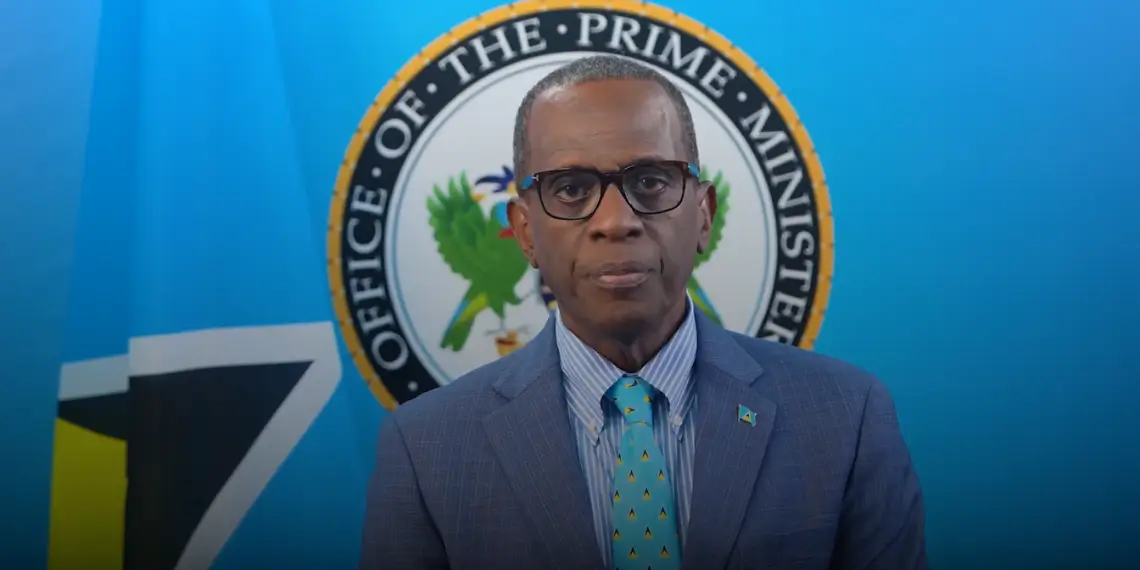
Speaking during his New Year’s address, Philip J Pierre said the MOU establishes a discretionary framework for cooperation with the United States on migration matters, including the possible handling of certain third-country nationals currently present in the US. He emphasized that the arrangement does not amount to an automatic acceptance policy and leaves all future decisions entirely at the discretion of the St Lucian government.
According to official presentation slides accompanying the address, the memorandum “establishes a framework for cooperation and does not trigger any immediate transfer or future engagements.” Pierre said the government retains full authority to determine if, when, and how any engagement under the framework would occur.
The prime minister also sought to reassure the public amid growing regional concern over deportation and migration arrangements between Caribbean states and Washington. He said St Lucia has received no indication of any change to US visa policy affecting St Lucians.
“As of today, there has been no information given to the government of Saint Lucia regarding any changes in the United States’ visa policy for Saint Lucians wishing to travel to the United States,” Pierre said.
St Lucia now joins several Eastern Caribbean nations that have acknowledged migration-related understandings with the US. Antigua and Barbuda, St Kitts and Nevis, and Dominica have all publicly confirmed similar arrangements or discussions as governments across the region respond to increased migration pressures and evolving diplomatic expectations from major international partners.
Similar arrangements have already been acknowledged elsewhere in the Eastern Caribbean. Antigua and Barbuda and Dominica previously confirmed cooperation frameworks tied to US asylum and migration policies, while St Kitts and Nevis disclosed a separate understanding linked specifically to US deportees.
Regional officials have described these memoranda as broad cooperation frameworks rather than binding agreements. They can include information sharing, border security coordination, and humanitarian considerations, while stopping short of obligating countries to accept US deportees or third-country nationals without explicit, case-by-case approval.
Pierre did not specify which categories of third-country nationals could potentially fall under the St Lucia framework, nor did he outline the conditions under which cooperation might be requested or approved. He said any engagement would be guided by national interest, existing laws, and the country’s regional and international obligations.
Migration and deportation have emerged as politically sensitive issues across the Caribbean, particularly as the US intensifies efforts to manage irregular migration and seeks greater cooperation from partner countries. Several governments in the region have faced public scrutiny over transparency, sovereignty, and the social impact of any arrangements involving third-country nationals.
In recent months, debate has intensified following disclosures by regional governments that they had entered into talks or agreements with Washington. Opposition figures and civil society groups in some territories have called for greater disclosure of the terms, safeguards, and limits contained in such memoranda.
Pierre reiterated St Lucia’s broader foreign policy stance, reaffirming the country’s commitment to the Caribbean as a “zone of peace.” He said St Lucia continues to be guided by dialogue, diplomacy, and respect for international law as a member of the Caribbean Community, known as CARICOM.
The full text of the memorandum of understanding has not been made public, and no timeline has been announced for any potential implementation. Pierre did not indicate whether the document would be tabled in Parliament or released for public review.
There was no immediate comment from US officials on the St Lucia agreement. In previous statements on similar arrangements in the region, Washington has characterized such frameworks as cooperative mechanisms designed to address shared migration challenges while respecting the sovereignty of partner nations.
Government officials in St Lucia have framed the MOU as a precautionary and exploratory step rather than a policy shift. Pierre emphasized that no transfers have been requested, approved, or scheduled under the agreement.
As regional migration dynamics continue to evolve, St Lucia’s decision highlights the balancing act facing Caribbean governments as they navigate diplomatic relations with major partners while addressing domestic concerns over transparency, national capacity, and social cohesion.