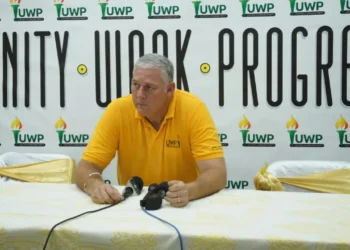
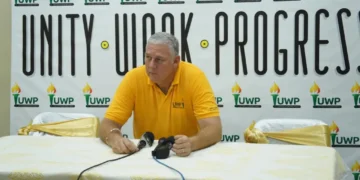
















CASTRIES, St Lucia — The question posed by NewsSpin on United Workers Party silence and why the opposition remains publicly quiet has ignited renewed political debate, drawing a forceful response from concerned citizen and political commentator Minerva Ward, who argues that responsibility for national outcomes lies squarely with the governing administration.
Ward’s comments were issued following a NewsSpin broadcast aired across Facebook, YouTube, and Power 97.9 FM, where the program questioned why the opposition has not been more vocal amid ongoing national concerns. Her response reframed the issue, asserting that silence from a one-seat opposition is neither abdication nor weakness, but a reflection of political reality and democratic accountability.
The exchange comes amid ongoing public debate over crime, governance, and economic decision-making under the current administration, as well as heightened public discussion about Saint Lucia’s Citizenship by Investment Programme and the country’s evolving diplomatic posture in a shifting international environment.
In her statement, Ward emphasized that the electorate delivered an overwhelming mandate to the current government, securing 16 of 17 parliamentary seats. She argued that such dominance carries an elevated responsibility to account directly to the public without deflection.
“With that level of power comes an even greater obligation to answer directly to the public,” Ward said. “Accountability, transparency, and access to information are not optional. They are duties owed to the people who put this government in office.”
Accountability, Power, and United Workers Party Silence
Minerva Ward rejected the framing that the opposition’s silence represents political failure, contending instead that the burden of governance cannot be shifted onto a marginal parliamentary minority.
“A government with near-total control cannot hide behind the opposition,” she said, adding that citizens should be demanding explanations from those in power rather than relying on a single-seat opposition to articulate public grievances.
Her comments underline a broader critique of political discourse that, in her view, misdirects public frustration away from governing authorities and toward opposition voices with limited institutional influence.
Minerva Ward also clarified that her remarks were made strictly in her capacity as a citizen, not as a spokesperson for the United Workers Party. However, she suggested that the party understands strategic restraint and the importance of timing in political engagement.
“For now, silence is golden,” she stated. “Let the people fully experience what they voted for, and let accountability fall exactly where it belongs, with the duly elected government.”
Five Years of Opposition Warnings Went Unheeded
The commentator further argued that the United Workers Party had already exhausted traditional opposition avenues over the previous parliamentary term, including frequent press conferences, town hall meetings, legal challenges, and judicial reviews on issues of national interest.
According to Ward, those efforts failed to resonate with voters, who ultimately delivered a decisive electoral verdict despite persistent warnings about governance failures.
She cited concerns such as rising homicide rates, the handling of the Citizenship by Investment Program, deteriorating infrastructure, stalled development projects, and the sale of national assets as issues the opposition consistently raised without gaining public traction.
“What is the opposition expected to say now that they didn’t say for five years?” Ward asked. “I told you so?”
Her remarks suggest that continued repetition of earlier warnings would neither advance national discourse nor compel corrective action.
Silence as Political Statement
Ward framed the current quiet from the opposition as a deliberate and strategic posture rather than political retreat. She described silence as a means of removing distraction and preventing the Saint Lucia Labour Party government from deflecting criticism by engaging in partisan conflict.
“At times, the most powerful statement is silence,” she said. “The void it creates speaks louder than any words.”
She argued that without an active opposition narrative to counter or blame, the government is left fully exposed to public scrutiny, with performance and outcomes standing on their own.
Ward concluded by reaffirming her commitment, as a citizen, to question government actions and demand standards of governance. She encouraged other Saint Lucians to adopt the same posture, emphasizing that democratic accountability does not rest solely with political parties, but with an engaged and vigilant electorate.
Ward closed her remarks with a pointed line that carried clear political irony.
“The mood is red,” she said, invoking the campaign slogan popularized by the governing Saint Lucia Labour Party during the election campaign, but doing so sarcastically as public frustration mounts under the very administration that popularized the phrase.
The comment was widely interpreted as a reversal of the governing party’s election messaging, now used to underscore growing dissatisfaction rather than celebration. By echoing the slogan, Ward appeared to suggest that the political mood has shifted from triumph to scrutiny, with citizens increasingly confronting the consequences of their electoral choice.
She reaffirmed that her position was not partisan but civic, stressing that democracy demands active engagement beyond election day.
“As a citizen of Saint Lucia, I will continue to question my government and demand standards,” Ward said, urging others to do the same.