


















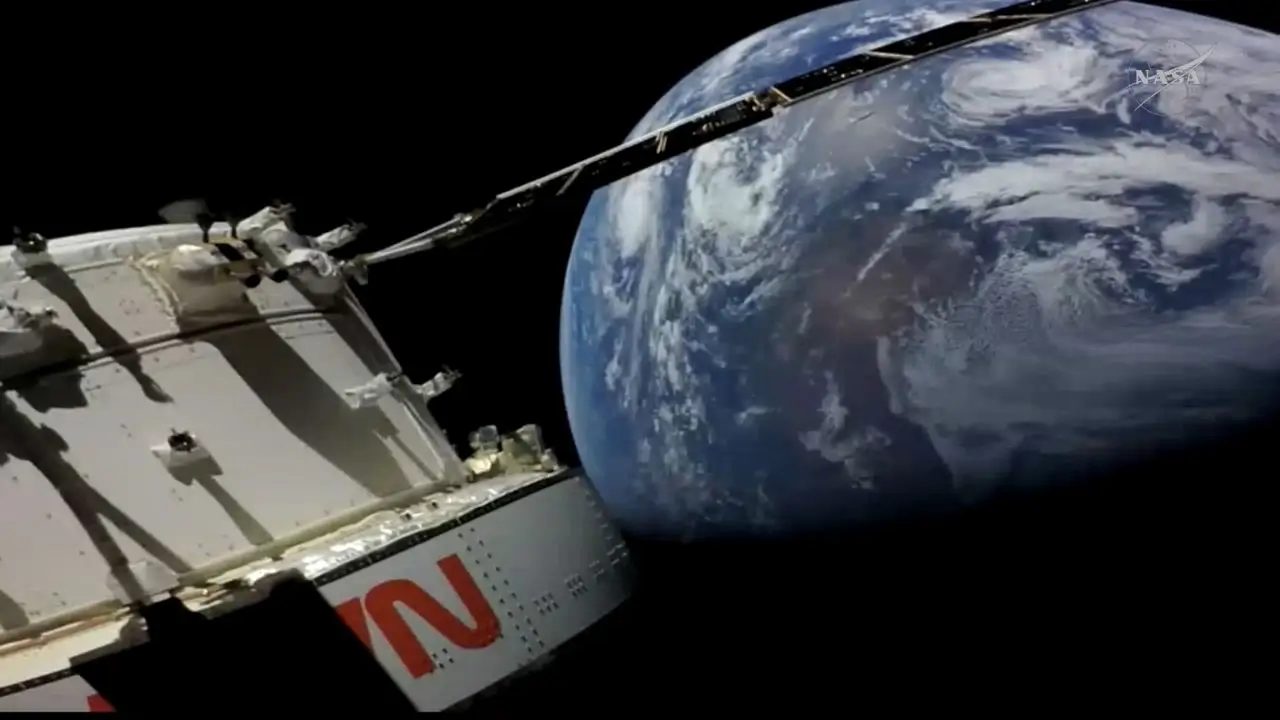
HOUSTON — NASA’s Artemis II Moon mission has entered the history books after successfully returning to Earth, breaking a 56-year distance record for human spaceflight and signaling a major step toward the return of astronauts to the Moon.
The crewed mission, which concluded with a Pacific Ocean splashdown, carried four astronauts around the Moon and back, reaching a maximum distance of approximately 252,756 miles from Earth. That milestone surpassed the previous record set by Apollo 13 in 1970, making Artemis II the farthest humans have traveled from Earth.
More than a symbolic achievement, the mission represents a critical test of systems that will support future lunar landings and long-duration deep-space missions.
Artemis II Moon mission surpasses historic Apollo-era distance
During its journey, the Orion spacecraft carried NASA astronauts Reid Wiseman, Victor Glover, and Christina Koch, alongside Canadian Space Agency astronaut Jeremy Hansen, on a trajectory that took them behind the Moon and into deep space.
The mission eclipsed the long-standing Apollo 13 record, ending a 56-year gap in human deep-space exploration beyond low Earth orbit. The achievement underscores NASA’s renewed push to reestablish a sustained human presence near and on the Moon.
Artemis II is the first crewed mission in NASA’s Artemis program and the first time astronauts have traveled to lunar space since the Apollo era.
Technology tests signal readiness for future lunar missions
Beyond the record-setting distance, the Artemis II Moon mission served as a proving ground for advanced systems designed for future exploration, making it one of the most significant recent developments in technology news.
Among the key technologies tested was Orion’s optical communications system, which uses laser-based transmission to send high-resolution data, imagery, and video back to Earth more efficiently than traditional methods. The system is expected to support future missions requiring faster and more reliable communication over greater distances.
NASA has emphasized that these tests are essential for upcoming missions that will aim not only to orbit the Moon, but to land astronauts near its south pole and eventually support longer-term habitation.
Safe return reinforces momentum toward Moon and beyond
Following re-entry into Earth’s atmosphere, the Orion spacecraft splashed down safely in the Pacific Ocean, where recovery teams retrieved both the capsule and crew for post-mission evaluations.
The successful completion of the Artemis II Moon mission provides NASA with critical data and operational confidence as it prepares for the next phase of lunar exploration.
With Artemis III expected to target a crewed Moon landing, Artemis II now stands as a pivotal mission that bridges the gap between past achievements and future ambitions, reopening the path for humans to once again walk on the lunar surface.