
















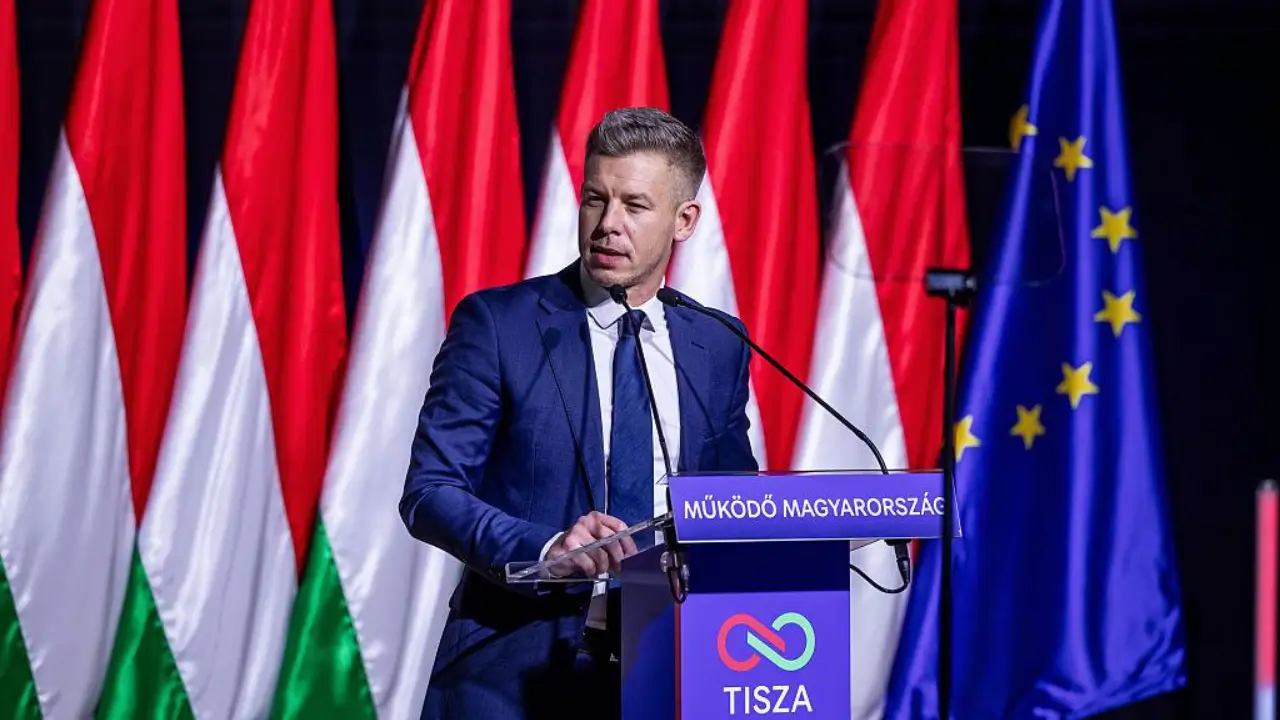
BUDAPEST, Hungary — Hungary election results delivered one of the most decisive political upheavals in the country’s post-communist history Sunday, as voters swept Prime Minister Viktor Orbán from power after 16 uninterrupted years and handed opposition leader Péter Magyar a commanding parliamentary landslide.
Preliminary results with 97.35 percent of precincts counted showed Magyar’s centre-right Tisza Party winning 138 seats in Hungary’s 199-seat National Assembly on 53.6 percent of the vote. Orbán’s Fidesz party, which entered the election controlling 135 seats, was reduced to 55 in a collapse that will reshape Hungary’s domestic politics and its role in Europe.
Turnout reached 76.5 percent, the highest recorded since Hungary began holding free elections in 1990. The scale of participation underscored the weight of an election widely viewed as a defining test of Hungary’s political future.
Hungary election results end Orbán era
Orbán conceded on election night, acknowledging that the outcome was unmistakable even before the final certification. He told supporters the result was painful but clear, and said the responsibility to govern had not been given to Fidesz.
The defeat ends one of Europe’s longest-serving nationalist administrations and closes a period in which Orbán became a defining figure for the continent’s far right. For many Hungarians, especially younger voters who had known no other prime minister, the result marked a political break with an era that had come to seem permanent.
Magyar cast the outcome as a mandate for national renewal. He told supporters that voters had chosen truth over lies and described the victory as an unprecedented democratic mandate in modern Hungary.
Tisza supermajority opens door to constitutional change
With 138 seats, Tisza moved beyond the 133-seat threshold required for a two-thirds constitutional supermajority. That gives Magyar’s government the power to amend Hungary’s constitution, the same framework Orbán’s administration used after 2010 to entrench its influence across the judiciary, state institutions, and the wider political system.
The consequence is immediate and far-reaching. Magyar now has the parliamentary strength not only to govern, but to dismantle core pillars of the Orbán model that shaped Hungarian public life for more than a decade.
Tisza has pledged to pursue anti-corruption reforms, restore judicial independence, and reverse elements of the Orbán-era constitutional order. The result also raises the prospect of a sharp reset in Hungary’s strained relationship with the European Union.
That matters financially as well as politically. A new course toward Brussels could help unlock billions of euros in EU funds that were suspended over democratic backsliding and rule-of-law concerns under the Orbán government.
Magyar’s rapid rise reshaped the contest
Magyar, 45, emerged as Hungary’s most potent opposition figure after breaking publicly with Fidesz and accusing the ruling establishment of corruption and systemic abuse. Barely two years ago, he was not seen as a serious challenger to Orbán’s hold on power.
He entered political life in 2024 and rapidly turned the Tisza Party into the country’s main opposition force. Campaigning as a moderate conservative with a pro-European message, he focused on corruption, economic stagnation, and the erosion of public services.
On election day, Magyar described the contest as a choice between East or West, propaganda or honest public discourse, corruption or clean public life. That framing helped elevate the race beyond party competition and into a referendum on Hungary’s political direction.
Bitter campaign heightened the stakes
The campaign was among the most polarised in recent Hungarian history. Orbán framed the election as a choice between war and peace, with government-backed messaging warning that Magyar would pull Hungary closer to the Russia-Ukraine conflict, an accusation Magyar denied.
The race was also shadowed by longstanding opposition concerns over the electoral playing field, including the influence of state media and an electoral map critics said favored Fidesz. Both sides raised concerns about possible irregularities even before ballots were counted, reflecting the level of distrust that surrounded the vote.
The final days of the campaign further heightened international attention. Support from prominent foreign political figures did not appear to shift the electorate, with turnout and margin suggesting Hungarian voters had already made up their minds in unusually large numbers.
Europe braces for Hungary policy shift
European leaders reacted with visible relief to a result likely to pull Hungary back toward the European mainstream. Orbán had repeatedly clashed with Brussels over democratic standards, sanctions policy, and Hungary’s stance toward Ukraine, issues that have shaped wider Europe coverage across the region.
His defeat also carries wider geopolitical consequences. It deprives Russian President Vladimir Putin of one of his most valuable allies within the European Union and could alter Hungary’s posture on Ukraine, sanctions, and EU collective decision-making.
The result will also reverberate across nationalist and far-right movements that had viewed Orbán as proof that illiberal governance could be sustained inside the EU. His removal from office is likely to be read not just as a national defeat, but as a symbolic setback for that broader political project.
Under Hungary’s constitution, the president must convene the inaugural session of the new National Assembly and propose a candidate for prime minister within 30 days of the election. That process is expected to formalize a transfer of power that few would have predicted with confidence even months ago.
The Orbán era is over. The question now is not whether Hungary has chosen change, but how far Magyar will go in trying to remake the state he inherits.