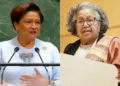



















PORT OF SPAIN, Trinidad and Tobago — Prime Minister Kamala Persad-Bissessar has issued a sweeping warning to criminal gangs and detainees released under emergency measures, saying the Kamala Persad-Bissessar SOE warning reflects her government’s readiness to swiftly reimpose a State of Emergency if violence resurges or public safety is threatened.
In a lengthy statement published on her official Facebook page, Persad-Bissessar said citizens were “fed up” with criminal activity and vowed that any renewed violence would be met with swift legal action. She warned that offenders would be returned to prison and that individuals who assist criminal activity, including friends and family members, could also face detention if evidence supports such action under existing laws.
The prime minister framed the warning as a necessary step to restore balance between public safety and criminal enforcement, insisting that all actions would be taken within the bounds of the law.
Crime reduction cited as Kamala Persad-Bissessar SOE warning intensifies
Persad-Bissessar linked her hardline stance to what she described as measurable improvements in national security, claiming Trinidad and Tobago recorded 257 fewer murders in 2025 compared with 2024. She attributed the reduction to a combination of American assistance in securing national borders, the leadership of Police Commissioner Allister Guevarro, and the detention of suspects under the State of Emergency using Prevention of Detention Orders.
Those figures have not yet been independently verified by the Central Statistical Office or formally confirmed in a public statistical release by the Trinidad and Tobago Police Service. However, the government has previously pointed to preliminary police data suggesting a downward trend in violent crime since the middle of 2025.
Persad-Bissessar said the security services and her administration are prepared for the conclusion of the current State of Emergency and remain ready to reinstate emergency powers should criminal activity escalate.
States of Emergency in Trinidad and Tobago are governed by constitutional and legislative safeguards that define the scope of detention and enforcement powers exercised by the executive and security services under parliamentary oversight.
Sharp rhetoric and warning to criminal networks
The statement marked one of the most forceful public interventions by the prime minister since her return to office. She dismissed criticism of her approach as outdated political messaging and said she would confront any attempt to destabilize the country head-on.
Persad-Bissessar warned that those who commit acts of violence against law-abiding citizens should expect an equally forceful response from the state, underscoring her view that deterrence is essential to restoring public confidence in national security.
While the language drew attention for its severity, the prime minister emphasized that her government’s actions would remain lawful, asserting that extraordinary measures are justified when citizens’ lives and safety are at risk.
Allegations against the opposition
The prime minister used the statement to level sweeping accusations against the opposition People’s National Movement, alleging that criminal financiers benefited politically from high crime rates during the party’s decade in office. She claimed that violence, fear, and instability were deliberately exploited to undermine public confidence and improve the opposition’s prospects of returning to government.
Persad-Bissessar further alleged that organized criminal networks relied on political influence to manipulate economic, financial, and national security policies, accusations she said enabled money laundering and sustained gang activity. No judicial findings have been issued to substantiate those claims, and the opposition has previously rejected similar allegations as politically motivated.
The broader debate over crime policy and enforcement has remained politically charged in Trinidad and Tobago, with senior political figures clashing publicly over whether existing crime laws are sufficient to combat gang violence and organized crime. That dispute has surfaced in earlier exchanges over legislative reform and enforcement strategy, including prior commentary on the effectiveness of crime legislation, which continues to shape the national security debate.
The People’s National Movement has not yet issued a public response to the latest remarks. In past statements, party officials have denied any association with criminal networks and accused the government of using inflammatory rhetoric to distract from governance challenges.
Legal and public reaction
Legal analysts note that while States of Emergency are permitted under Trinidad and Tobago’s Constitution, their implementation requires strict oversight to ensure due process protections are maintained. Detention powers and enforcement actions can face legal challenges if applied too broadly or without sufficient evidentiary standards.
Human rights advocates have previously cautioned that emergency powers, though lawful, must be exercised proportionately to avoid abuse. At the same time, public frustration over crime has remained high, with many citizens calling for stronger enforcement and visible results.
Persad-Bissessar concluded her statement by reaffirming that her government’s priority is the protection of law-abiding citizens. She said the administration will continue to use every lawful tool available to suppress violent crime and prevent criminal networks from reasserting influence.