

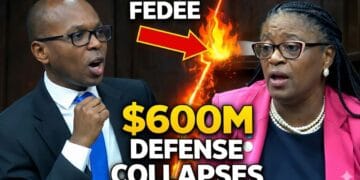







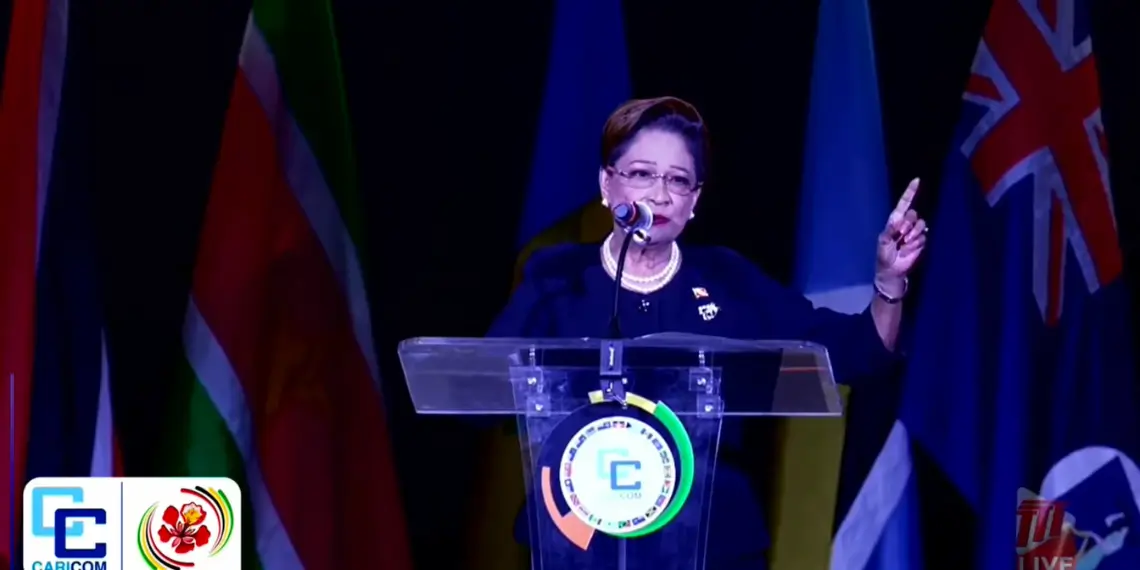
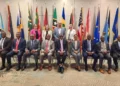
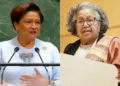
BASSETERRE, St Kitts and Nevis — Kamla Persad-Bissessar blasted CARICOM over what she described as regional silence on security threats, political interference, and democratic inconsistencies, delivering one of the most confrontational addresses at the opening of the CARICOM Heads of Government Meeting.
The Trinidad and Tobago Prime Minister departed from customary diplomatic language and instead challenged fellow leaders to confront difficult realities facing the region, from rising crime to geopolitical pressure. Details were first reported by PPSL News 24/7.
Deportation dispute raises accountability concerns
Persad-Bissessar revisited the October 2022 removal of a Trinidad and Tobago national from another CARICOM state, an action she said was later ruled by that country’s Supreme Court to amount to kidnapping.
She disclosed that while serving as Opposition Leader, she wrote formally to the CARICOM Secretariat seeking clarification, but has not received a response. The unanswered request, she suggested, raises questions about transparency and equal treatment within the regional body.
She cautioned that CARICOM must never become an instrument to shield political allies or ignore citizens based on party alignment. Many leaders, she noted, have served in opposition and could return there.
The Prime Minister also condemned what she described as political parties from CARICOM states campaigning in the domestic elections of other member countries, arguing that such involvement erodes trust and unity.
After Kamla Persad-Bissessar Blasted CARICOM, security took center stage
Persad-Bissessar then shifted to national security, citing 623 murders recorded in Trinidad and Tobago in 2024 within a population of approximately 1.4 million. She said about 40 percent were linked to gang and narcotics activity.
Rejecting the notion that the region can be described as a “zone of peace” amid escalating violence, she defended her government’s security cooperation with the United States and argued that regional messaging must match on-the-ground realities, echoing her earlier position on the CARICOM “zone of peace”.
The Prime Minister also referenced threats made against Trinidad and Tobago and Guyana by Venezuela, questioning whether the regional response has been sufficiently firm. While affirming respect for sovereign foreign policy choices, she signaled that her government will pursue policies guided by national security priorities.
Democracy, Haiti and migration pressures
Persad-Bissessar addressed governance standards across the region, pointing out that leaders at the CARICOM table were elected in democratic processes. She questioned why Caribbean nations should embrace democracy while remaining silent on the restrictions faced by Cuban citizens.
She declared that Trinidad and Tobago would not support dictatorship “in Cuba or anywhere else,” reaffirming commitment to the rule of law, separation of powers, and freedom of expression.
On Haiti, she pledged support for a United States and Panama-backed gang suppression initiative aimed at restoring order amid escalating violence, warning that unchecked criminal networks could destabilize neighboring states.
Migration pressures were also highlighted. Persad-Bissessar noted Trinidad and Tobago’s proximity to Venezuela, approximately seven miles at its closest point, and said the country is managing tens of thousands of illegal migrants. While expressing support in principle for full and free movement within CARICOM, she stressed that national interest must come first.
Commitment to CARICOM, with a demand for action
Despite the sharp tone, Persad-Bissessar reaffirmed Trinidad and Tobago’s commitment to regional integration. She invited CARICOM nationals to utilize expanded tertiary education opportunities at the University of the West Indies South Campus and offered access to the Couva Children’s Hospital.
However, she closed with a call for measurable results, urging leaders to move beyond speeches and summit themes toward concrete action. Her warning lands amid wider debate over whether CARICOM has become dysfunctional and unable to deliver practical outcomes on shared challenges.
For smaller Caribbean states such as St Lucia, where regional security coordination, migration management, and diplomatic cohesion directly influence economic stability and public safety, the issues raised underscore ongoing tensions between collective diplomacy and national sovereignty.










Yes… say it like it is
Despite the fact that her country has diplomatic relations with Saudi Arabia, Kuwait, Qatar, the United Arab Emirates, and Israel, despite committing epic genocide in Gaza, and after pressing Donald Trump for bringing violence to Venezuela and the Wider Caribian, she explicitly stated that Trinidad and Tobago, under her leadership, would not support a dictatorship in Cuba or elsewhere. Hmmm