





Students, professionals, and even officials feel the impact as passport credibility comes under scrutiny
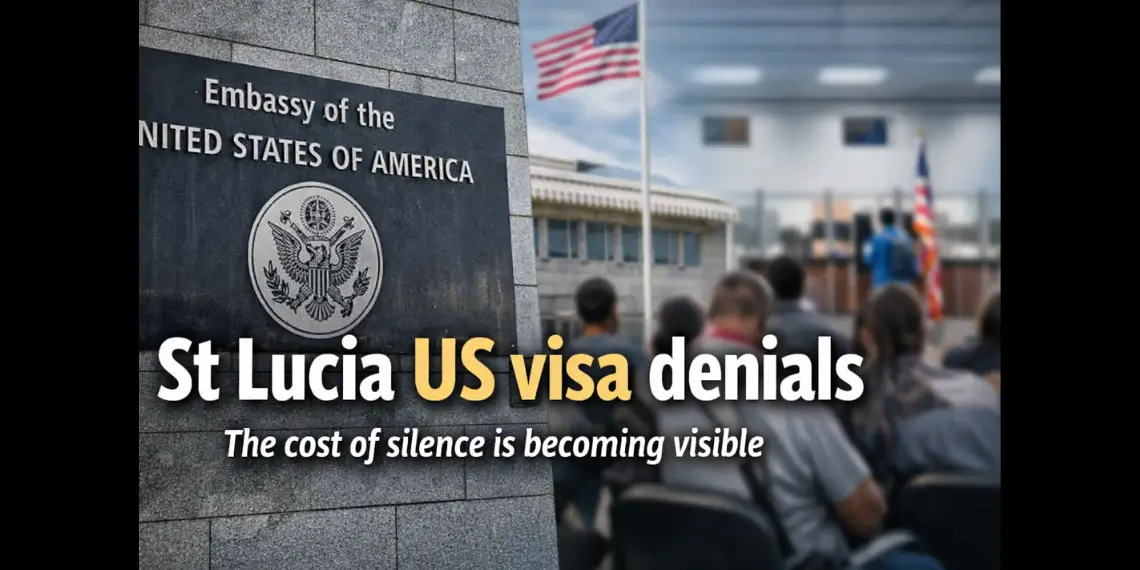
BRIDGETOWN, Barbados — St Lucia US visa denials are no longer abstract policy outcomes; they are unfolding in real time, affecting students, professionals and even senior officials. Inside the US Embassy in Bridgetown this week, St Lucian applicants, including a student bound for New York this January and a government minister seeking a personal visa, waited for decisions that would ultimately underscore the growing consequences of diplomatic silence and weakened passport credibility.
A young St Lucian student sat at the US Embassy in Bridgetown on Thursday waiting to learn the outcome of her visa application. She had applied for a student visa to attend school in New York in January. Everything was already in place: conditional acceptance from the school, financing secured, accommodation arranged. The only thing missing was approval of her U.S. visa.
She was not the only St Lucian waiting to be called to the counter.
Several other St Lucians awaited their decisions, including a St Lucian government minister who had applied for a personal U.S. visa. One after another, applicants were called forward. One after another, decisions were delivered not quietly, not discreetly, but loudly enough for everyone in the waiting area to hear.
Denied.
The word echoed across the room.
St Lucians who had previously held U.S. visas, with no history of overstaying, were denied. Students seeking nothing more than the opportunity to further their education were denied. When the minister protested that he was a government official, the response was blunt: “We cannot issue you with a U.S. visa at this time.”
This was not coincidence. This was consequence.
U.S. security warning puts Caribbean citizenship programmes under scrutiny
On Dec. 16, 2025, the United States issued a clear and unequivocal warning that poorly regulated Citizenship by Investment programs (CBI) pose a direct risk to U.S. security. The warning was not abstract. It was not academic. It was directed squarely at countries that continue to sell citizenship without sufficient transparency, oversight, and accountability, countries that treat passports as revenue tools rather than instruments of national sovereignty and international trust.
Similar concerns have already translated into concrete policy action elsewhere in the region, including recent U.S. travel restrictions imposed on Antigua and Dominica, underscoring that heightened scrutiny is no longer theoretical.
The implication was unmistakable. Where citizenship credibility erodes, mobility follows.
A region under heightened scrutiny
At the same time, the geopolitical temperature in the Caribbean has risen sharply. Venezuela’s increasingly aggressive posture in regional waters, the expanding US national security presence in response, and the expectation that Caribbean states clearly articulate where they stand have fundamentally changed the diplomatic environment.
In this climate, silence is no longer neutral. Silence is interpreted.
Government silence, public consequences
And yet, in the face of a US national security warning, escalating regional tensions, and a visible rise in St Lucia US visa denials affecting ordinary citizens, the Government of Saint Lucia has said nothing.
No statement.
No explanation.
No reassurance to students, families, businesspeople, or even its own ministers.
Instead, St Lucians are left to piece together the reality themselves, standing humiliated at embassy counters, hearing the word denied echo across waiting rooms, watching doors quietly close on educational and economic opportunities they did everything right to secure.
Citizenship credibility on the line
This government has failed in its most basic duty: to protect the credibility of Saint Lucian citizenship and to speak honestly to its people when that credibility is under threat.
Other Caribbean governments have acknowledged the seriousness of the moment, reviewed their programmes, and engaged their international partners. Saint Lucia has chosen denial not at the embassy counter, but at the level of leadership.
Who pays the price
A passport is not just a document. It is a reflection of a country’s governance, judgment, and values. When that passport becomes suspect, it is not the political elite who suffer first. It is students, workers, families, and young people with dreams bigger than this government’s willingness to act.
The question is no longer whether something is wrong. The question is how much more damage will be done before this government finds its voice or its conscience.
For continued coverage and analysis on developments affecting St Lucia and the wider region, follow Unitedpac St Lucia News.