















White House expands U.S. travel restrictions to Antigua and Barbuda, Dominica
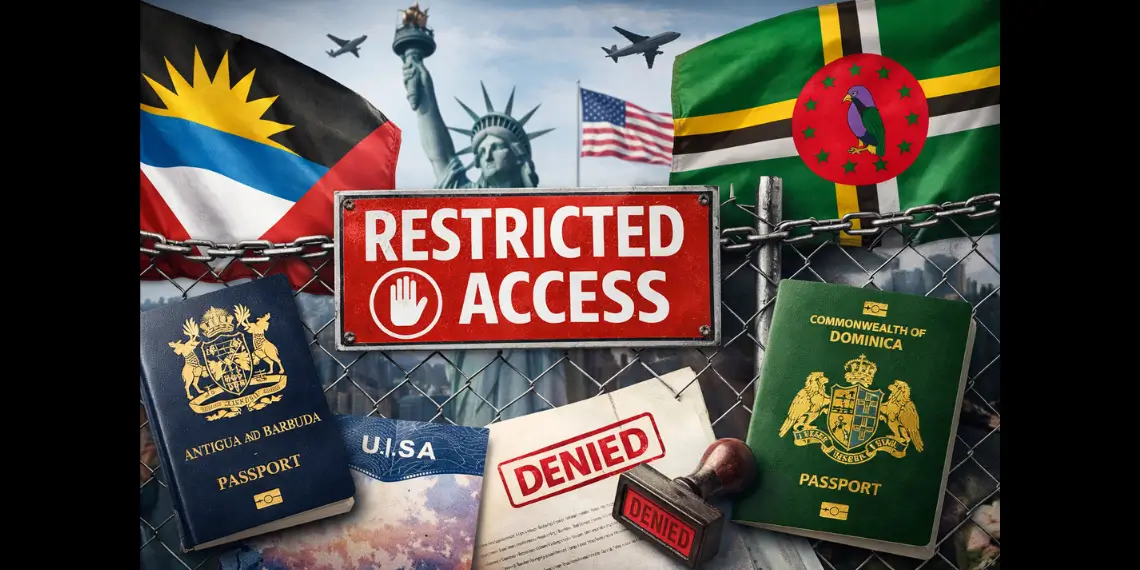
WASHINGTON —The United States will impose new U.S. travel restrictions on nationals of Antigua and Barbuda and Dominica beginning Jan. 1, 2026, citing national security concerns linked to weak screening systems and the long-standing operation of citizenship-by-investment programs that allow individuals to obtain passports without residency.
The expanded U.S. travel restrictions build on a broader Trump administration policy that earlier targeted 19 countries over national security and vetting concerns, detailed in Unitedpac St Lucia News’ coverage of the Trump travel ban 2025 and restrictions on 19 nations.
The restrictions were announced in a sweeping White House proclamation signed by President Donald Trump on Dec. 16, 2025, expanding and modifying earlier U.S. travel controls that were reinstated earlier this year. The measures partially suspend entry into the United States for nationals of 15 countries, including the two Eastern Caribbean states, under the administration’s broader effort to tighten immigration vetting and curb document fraud, visa overstays, and exploitation of U.S. immigration laws.
Under the proclamation, nationals of Antigua and Barbuda and Dominica will be barred from entering the United States as immigrants and on several nonimmigrant visa categories, including B-1, B-2, and B-1/B-2 visitor visas, as well as F, M, and J student and exchange visas. U.S. consular officers are also instructed to reduce the validity of other nonimmigrant visas issued to nationals of both countries where legally permissible.
The restrictions apply only to individuals who are outside the United States on the effective date and who do not already hold valid U.S. visas. Visas issued before Jan. 1 will not be revoked under the proclamation.
Citizenship-by-investment programs cited
The White House singled out Antigua and Barbuda and Dominica for their historical operation of citizenship by investment programs that grant nationality without a residency requirement. According to the proclamation, such programs pose heightened risks to U.S. screening and vetting systems by enabling individuals to obscure their true identities or national origins.
U.S. authorities warned that a foreign national from a restricted country could obtain citizenship from a second country offering citizenship by investment, secure a passport, and then apply for a U.S. visa under that new nationality, effectively bypassing existing travel controls.
The administration said U.S. law enforcement and the State Department have found that citizenship-by-investment schemes have historically been vulnerable to abuse, including the concealment of assets, identity manipulation, and circumvention of travel or financial restrictions.
“These risks include allowing an individual to conceal his or her identity and assets to circumvent travel restrictions or financial or banking restrictions,” the proclamation states.
Part of expanded security review
The new measures build on Executive Order 14161, signed on Jan. 20, 2025, and Proclamation 10949, issued in June, which reinstated and expanded Trump-era travel restrictions previously upheld by the U.S. Supreme Court. The policy directs U.S. agencies to assess whether foreign governments meet minimum standards for identity management, civil documentation, information sharing, and cooperation on immigration enforcement.
The proclamation argues that deficiencies, such as poor record-keeping, unreliable civil documents, corruption, and inaccessible criminal records, prevent U.S. authorities from confidently determining whether visa applicants pose security or public safety risks.
While Antigua and Barbuda and Dominica are not accused of harboring terrorist organizations, the administration grouped them among countries presenting structural vulnerabilities that, in its view, undermine the reliability of U.S. vetting systems.
Exceptions and waivers
The restrictions do not apply to lawful permanent residents of the United States, dual nationals traveling on passports from non-designated countries, or individuals holding certain diplomatic, NATO, or international organization visas. Athletes and support personnel traveling for major international sporting events, as well as specific U.S. government-related special immigrant visas, are also exempt.
Case-by-case waivers may be granted if the Secretary of State, Secretary of Homeland Security, or Attorney General determines that travel would serve a U.S. national interest, including participation in criminal proceedings or other critical government functions.
The proclamation does not affect individuals already granted asylum or refugee status and preserves the right to seek asylum or protection under U.S. and international law.
Regional implications
The inclusion of Antigua and Barbuda and Dominica is expected to draw close attention across the Caribbean, where citizenship-by-investment programs have played a significant role in government revenue and economic policy. Although several Caribbean governments have taken steps in recent years to strengthen due diligence and oversight, the U.S. action signals continued skepticism in Washington about the effectiveness of those reforms.
The State Department is required to engage immediately with affected countries on steps needed to meet U.S. screening and vetting requirements. The restrictions will be reviewed every 180 days, with the possibility of modification, expansion, or removal depending on compliance and cooperation.
The White House said the measures are intended both to protect U.S. national security and to pressure foreign governments to improve identity management systems, reduce fraud, and share reliable information with U.S. authorities.
For continued coverage of this developing story and its implications for the Caribbean, follow Unitedpac St Lucia News for breaking updates and in-depth reporting.