






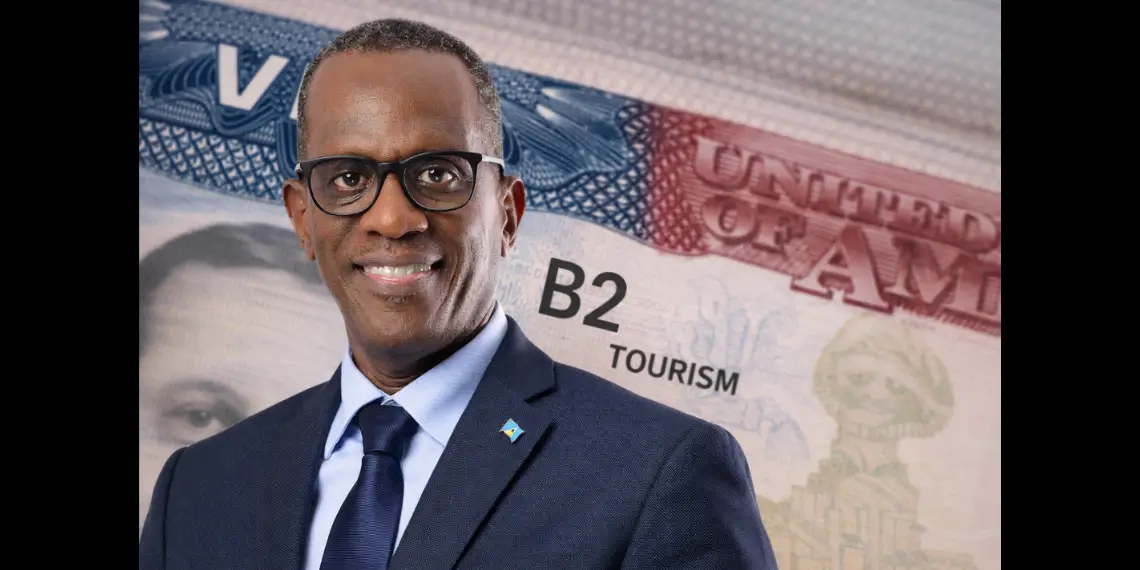
As the US freezes visas for St Lucia, scrutiny intensifies over citizenship programs and foreign policy
WASHINGTON — As the US freezes visas for St Lucia beginning Jan. 21 as part of a sweeping action affecting 75 countries, the decision has thrust the island into renewed international scrutiny over citizenship-by-investment oversight, foreign policy missteps and the leadership of Prime Minister Philip J Pierre.
The decision, outlined in an internal US State Department memo obtained by Fox News Digital, instructs consular officers worldwide to deny immigrant visas under existing legal authority while Washington undertakes a comprehensive review of screening and vetting standards. The pause will remain in effect indefinitely, immediately affecting St Lucians seeking migration opportunities tied to education, employment, family reunification, and long-term travel to the United States.
St Lucia appears on the list alongside Antigua and Barbuda, Dominica, Grenada, Saint Kitts and Nevis, and Saint Vincent and the Grenadines, a grouping that has renewed focus on Caribbean citizenship-by-investment, or CIP, programs long criticized by US and European officials for weak oversight and vulnerability to abuse.
While the State Department has framed the move as a domestic immigration enforcement measure linked to the “public charge” provision of US law, the inclusion of multiple Caribbean states has sharpened questions about governance failures in the region and, in St Lucia’s case, about political responsibility under Pierre’s administration.
Caribbean CIP programs under mounting international pressure
US officials have repeatedly warned that poorly regulated citizenship programs pose national security and financial crime risks. Senator Marco Rubio and other American lawmakers have publicly linked Caribbean passports to money laundering networks, drug trafficking routes and sanction-evasion schemes connected to Venezuela and other high-risk jurisdictions. Similar concerns have surfaced in European Union discussions on tightening visa-free access for Caribbean states.
Under updated guidance circulated to consular posts in November 2025, US officers are now directed to apply the public charge standard more aggressively, examining applicants’ health, age, financial resources, English-language ability and potential need for long-term medical care. State Department spokesperson Tommy Piggott said Washington would rely on long-standing authority to deny entry to individuals likely to depend on taxpayer-funded assistance, adding that exceptions during the pause would be rare.
The list of affected countries is sweeping, spanning Afghanistan, Bahamas, Barbados, Belize, Brazil, Cuba, Haiti, Jamaica, Russia, Somalia and Yemen. Yet the clustering of small Caribbean nations has amplified the perception that Washington is responding to broader concerns about lax controls, political interference, and weak governance in citizenship sales.
Foreign policy missteps compound U.S. concerns
The visa freeze also follows a series of foreign policy decisions that have strained St Lucia’s relationship with key international partners, particularly the United States. Recent remarks by senior St Lucian officials at a CELAC forum triggered diplomatic backlash after appearing to downplay U.S. security priorities and regional alignment concerns, according to earlier reporting on the government’s foreign policy fallout.
Regional analysts warned at the time that the comments risked reinforcing perceptions in Washington that St Lucia’s foreign policy posture was drifting away from traditional allies at a moment when US authorities were reassessing relationships with governments viewed as unreliable on security cooperation, illicit finance, and geopolitical alignment.
Diplomats familiar with the region say such episodes, when combined with longstanding concerns surrounding citizenship-by-investment oversight, contribute to a cumulative erosion of trust. In St Lucia’s case, that erosion has unfolded under Prime Minister Pierre, who holds ultimate authority over both the country’s foreign policy direction and national security governance.
Pressure focuses on Philip J Pierre and Ernest Hilaire
In St Lucia, critics argue that the visa freeze is not an abstract foreign policy development but the predictable outcome of years of ignored warnings. They place responsibility directly on Pierre, who has repeatedly maintained that he is unaware of wrongdoing within the CIP, a claim opponents now dismiss as implausible given the scale of international concern.
Attention has also focused on Ernest Hilaire, the minister responsible for investment and tourism and deputy political leader of the governing party, who has been one of the most vocal defenders of the program. Allegations of unlawful passport sales and black-market activity, while denied by the government, have circulated widely in regional and international commentary, steadily eroding confidence in St Lucia’s safeguards.
Critics further cite the continued political prominence of controversial figures and what they describe as a tolerance for reputational risk that signaled weak governance standards to international partners. In their view, Pierre’s insistence that he “knows nothing” has become a liability, reinforcing perceptions of either willful blindness or a lack of control at the highest level of government.
“This did not happen overnight,” said one regional security analyst. “For years, concerns were raised about oversight, vetting and political accountability. When leadership dismisses those concerns, external consequences are inevitable.”
Consequences now borne by ordinary St Lucians
The immediate fallout will be felt not by policymakers but by ordinary citizens. Beginning Jan. 21, immigrant visa issuance for St Lucians will be suspended, with increased scrutiny expected even for future applications once processing resumes. Students, business owners, and families planning lawful migration now face uncertainty and delay, while the country’s international standing absorbs another blow.
Opposition figures warn that failure to act decisively could push St Lucia toward deeper diplomatic and economic isolation, particularly if US concerns intersect with parallel European actions on travel access. They argue that restoring trust will require more than assurances from a prime minister who has repeatedly denied responsibility while the consequences escalate, demanding transparent reform of citizenship programs and clear political accountability.
The visa freeze has transformed what the government once portrayed as manageable external criticism into a concrete sanction with real-world consequences. For many St Lucians, it has crystallized a broader question of leadership, whether the nation’s credibility was actively safeguarded or quietly allowed to erode while those at the top claimed ignorance.
As Washington’s policy takes effect, pressure is mounting on Prime Minister Pierre to answer that question publicly.








75 countries including Bahama, Barbados, and even Brazil, so CIP is not the key issue for this immigrant visa suspension.
Antigua is the only country in the region that requiring newly registered citizens to stay in the country for at least five days within five years since the registration, and so the reason for “no connection” is also an alleged false indication compared with other four especially Dominica. There must be other reasons behind for the US to impose the sanction.
By the way, it may not be a bad idea to evolve from the CBI to RBI to respond the US-EU concerns. Movement of capital and people will ultimately benefit the whole region, it is not a bad initiative to boost our economy by welcoming people to invest and stay. All the best, for Caribbean.