








Former WTO advisor warns of implications for visas, diplomacy, and trade
CASTRIES, St Lucia — A widening US policy shift in the Caribbean is placing St Lucia and the wider CARICOM bloc under renewed scrutiny, as Washington recalibrates its foreign policy priorities and signals a tougher, more bilateral approach toward the region.
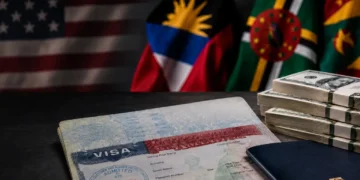
The shift is anchored in the Trump administration’s 2025 National Security Strategy, which elevates Latin America and the Caribbean to the highest tier of US strategic importance for the first time in decades. The repositioning comes amid recent US actions restricting visa access for citizens of Antigua and Barbuda and Dominica, raising concerns across the Eastern Caribbean about the potential knock-on effects for diplomacy, trade, and regional autonomy.
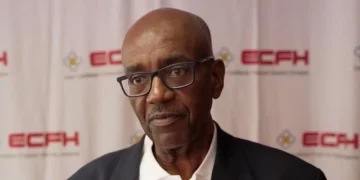
In the commentary below, Stephen Fevrier, former OECS ambassador to the United Nations in Geneva and a former senior advisor to the director general of the World Trade Organization, examines what this US policy shift in the Caribbean means for St Lucia and CARICOM, warning that small states now face heightened scrutiny over foreign policy alignment, citizenship by investment programs, and economic dependence on the United States.
The commentary below is published in full and reflects the views of the author.
What the return of US hemispheric primacy means for Saint Lucia and CARICOM
By Amb. Stephen Fevrier
Former OECS ambassador to the United Nations in Geneva and former senior advisor to the director general of the World Trade Organization
Saint Lucia and CARICOM are coming under scrutiny by the Trump administration in what may prove to be the most significant shift in US foreign policy toward the Caribbean in a generation. The White House proclamation imposing sanctions on Antigua and Barbuda and Dominica by restricting visa access is the clearest example of a new and more assertive posture towards the region. This should not come as a surprise, given the signals from Washington since the start of the new Trump administration.
On December 5, the Trump administration issued its 2025 National Security Strategy, a document that outlines Washington’s foreign policy principles and priorities. Traditionally released at the beginning of a new administration, the strategy outlines how the US intends to engage the world and define its key strategic interests.
The 2025 National Security Strategy should command the full attention of Saint Lucia and CARICOM.
For decades, America’s focus drifted away from the Caribbean toward the Middle East and the Asia-Pacific. Since the end of the Cold War, engagement with the region had been deprioritised, resulting in limited high-level contact and modest strategic attention. From the 1990s until now, successive National Security Strategies ranked Latin America and the Caribbean as regions of low to moderate strategic importance. Even during the first Trump administration, the 2017 strategy placed the region last.
The 2025 strategy breaks decisively with that history. For the first time, Latin America and the Caribbean are ranked as a region of very high strategic importance and, more crucially, as the top global priority. Asia, once first, now ranks second. Europe has slipped to third, followed by the Middle East, with Africa ranked last.
This reshuffling is not symbolic. It signals a return to a hard-edged US focus on the western hemisphere.
Equally important is what the strategy deprioritises. Multilateral institutions are explicitly downgraded, with the document reaffirming the primacy of the nation state. Washington has progressively disengaged from various multilateral organisations, notably the United Nations. This not only marks a clear departure from US internationalism but also has direct implications for engagement between Washington and CARICOM.
The pattern is already visible. Trump’s first engagement with CARICOM leaders in 2019 did not occur through formal CARICOM structures, but through an irregular meeting at Mar-a-Lago with leaders aligned with Washington’s position on Venezuela.
Despite reported requests from CARICOM heads of government to the current administration for engagement with the White House, no formal Trump-CARICOM summit has followed. This is not a coincidence. For Trump, bilateralism is replacing plurilateral or multilateral approaches, weakening CARICOM’s ability to represent and advance the collective interest of the region.
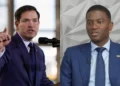
This trend has been confirmed in recent interactions with Washington. In March 2025, US Secretary of State Marco Rubio held bilateral talks with leaders from Jamaica, Guyana, and Suriname during his Caribbean tour. In May, he hosted seven CARICOM heads of government in Washington for discussions on regional cooperation. Even then, engagement was limited and selective.
In trade and economic relations, the US has shifted away from non-reciprocal preferences under the Caribbean Basin Economic Recovery Act, a 1983 US trade programme providing duty-free access for most goods originating in the region. A differential and bilateral tariff regime now applies, with CARICOM states receiving individual 10 per cent tariff treatment.
US interest in the region is not new and has ebbed and flowed over the centuries according to identified security concerns. The first clear articulation of the need for hemispheric primacy came in 1823 when President James Monroe enunciated what became known as the Monroe Doctrine, effectively declaring the western hemisphere off-limits to European interference. That doctrine was expanded in 1904 through Theodore Roosevelt’s Corollary, asserting the US right to intervene across the region. Interventions in Cuba, Haiti, Grenada and Nicaragua were implicitly justified under this unilateral doctrine.
The 2025 National Security Strategy represents a modern Trump corollary.
It reasserts US primacy in the western hemisphere, particularly in response to China, Russia, Iran, and Cuba and Venezuela. The Caribbean is once again framed as a privileged sphere of US interest. The strategy is explicit in its intent to deny external strategic competitors the ability to deploy forces in the region or to own and control strategically vital assets. In other words, no other foreign power should hold a dominant position in the Latin American and Caribbean region.
For Saint Lucia, the implications are sobering.
First, the growing leftward drift in parts of the OECS will attract heightened scrutiny from Washington. Notably, relationships with the Maduro regime in Venezuela will not escape attention.
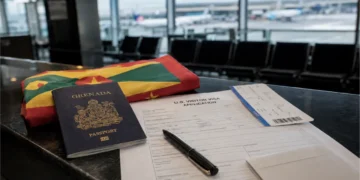
Second, it would not have escaped notice that the US is already taking steps to restrict visa access for citizens of the region for security concerns. In this context, the risks associated with Saint Lucia’s Citizenship by Investment Programme to US homeland security will continue to draw attention. There is a real risk that continued access to the US may be subject to review should Saint Lucia fall out of compliance with policy expectations. This risk should not be underestimated, especially in light of the US proclamation issued on December 16 partially restricting the issuance of visas to citizens of Antigua and Barbuda and Dominica.
Third, Saint Lucia’s foreign policy choices, particularly as they relate to China and other strategic competitors of the US, will come under closer examination. The stated intent of Washington to exert influence over the region will likely come into conflict with the exercise of foreign policy decisions.
Recent extraterritorial and extrajudicial practices, including actions against boats moving through international waters, are likely to continue without recourse. There is also a real possibility of an expanded ship-rider arrangement and maritime enforcement.
Finally, the economic dimension cannot be ignored. Saint Lucia and the region heavily rely on the US for their economic well-being. The risk of actions such as travel advisories and visa restrictions could negatively impact tourist arrivals and limit financial and investment flows to the region.
The message is clear. The Caribbean is back at the centre of US strategic thinking, but on Washington’s terms. For Saint Lucia and CARICOM, the challenge is not whether this shift will affect us, but whether we are ready to respond with clarity, unity, and strategic purpose.
Amb. Stephen Fevrier is a former OECS ambassador to the United Nations in Geneva and a former senior advisor to the director general of the World Trade Organization. He holds a bachelor’s degree in political science, a bachelor of laws, and a master’s degree in international commercial law.
For continued analysis on regional geopolitics, diplomacy, and Caribbean affairs, follow Unitedpac St Lucia News for more in-depth coverage.