












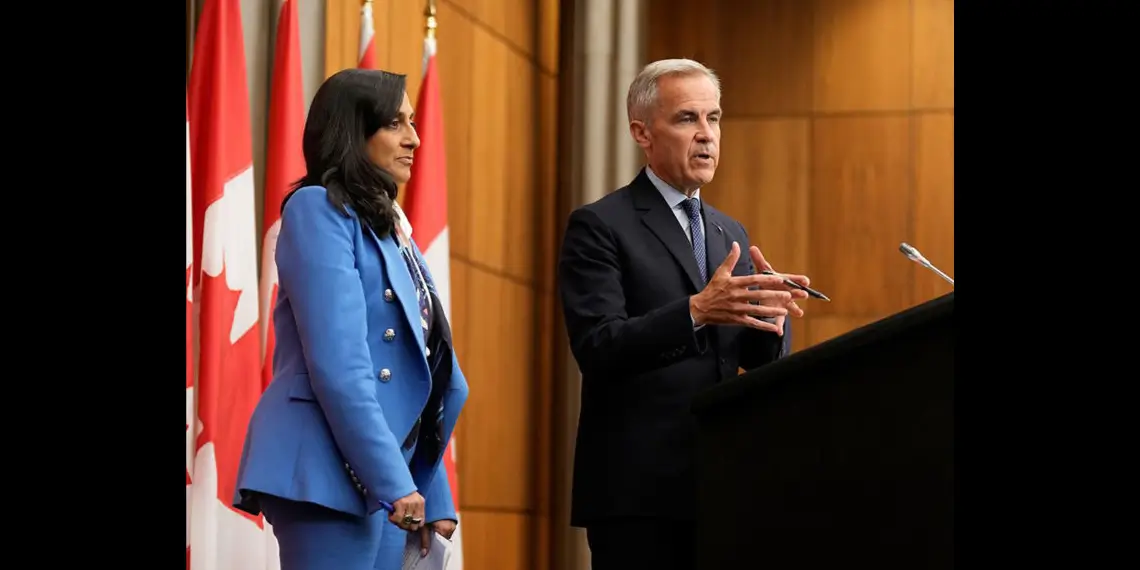
OTTAWA, Canada — Canada Backs U.S. on Iran in a new federal statement warning that Tehran must never be allowed to obtain or develop nuclear weapons, as Iran-related hostilities continue to unfold across the Middle East.
Prime Minister Mark Carney and Foreign Affairs Minister Anita Anand said the Canadian government is closely monitoring the situation and urged Canadians in Iran to shelter in place. Canadians elsewhere in the region were advised to follow local guidance and take all necessary precautions.
In the statement, Canada described the Islamic Republic of Iran as the “principal source of instability and terror” in the Middle East and cited Iran’s human rights record as part of Ottawa’s rationale for maintaining pressure on Tehran. The government reiterated that preventing an Iranian nuclear weapon remains a central national security priority.
The statement, dated February 28, 2026, did not announce new sanctions or military measures. It positioned Canada’s approach as a combination of diplomatic pressure, existing sanctions policy, and support for allied efforts aimed at limiting Iran’s nuclear capabilities.
Diplomatic pressure builds as Canada Backs U.S. on Iran
Carney and Anand said Canada and its international partners have “consistently” called on Iran to end its nuclear program, pointing to discussions at the 2025 G7 Leaders’ Summit in Kananaskis and the United Nations’ reimposition of sanctions in September.
Despite those efforts, the statement said Iran has not fully dismantled its nuclear program, halted enrichment activity, or ended support for what Canada described as regional terrorist proxy groups.
The government also said Canada “stands with the Iranian people” against what it called an oppressive regime, framing Ottawa’s stance as both a security policy and a response to Iran’s internal repression.
Canada’s endorsement of U.S. actions was explicit. The statement said Ottawa supports the United States “acting to prevent Iran from obtaining a nuclear weapon” and to stop the Iranian regime from further threatening international peace and security.
Officials did not provide operational details or timelines, and the statement did not specify which U.S. actions Canada was referencing beyond the stated objective of preventing a nuclear weapon.
Sanctions, IRGC listing, and calls to protect civilians
Carney and Anand said Canada has listed the Islamic Revolutionary Guard Corps as a terrorist entity and has sanctioned 256 Iranian entities and 222 individuals, describing the measures as a response to Iran’s repression and what the statement called persistent violence beyond its borders.
Ottawa also reaffirmed Israel’s right to defend itself and ensure the security of its people, while adding a separate appeal for civilian protection as tensions escalate.
“The Canadian government urges the protection of all civilians in this conflict,” the statement said, underscoring a humanitarian emphasis alongside Canada’s security alignment with Washington.
For Canadians with relatives, business ties, or travel in the region, the government’s advisory language carries immediate practical implications. Shelter-in-place guidance and broader cautionary messaging signal that Ottawa views the security environment as volatile, with potential risks that can shift quickly depending on developments on the ground.
The statement also addressed Canada’s responsibilities to its citizens and diplomatic footprint abroad. Carney and Anand said the government will take “all possible measures” to protect Canadian nationals and Canadian diplomatic missions throughout the region.
While Ottawa’s language was firm on Iran’s nuclear ambitions and regional role, it did not outline specific next steps or any changes to Canada’s posture beyond continued monitoring, existing sanctions policy, and public alignment with U.S. efforts.