






By St Lucian Patriot | Commentary
This commentary was submitted by St Lucian Patriot. The views expressed are solely those of the author.
CONTROVERSIAL POST
Confronting Repression is not about personality politics. It is about whether governments accused of killing their own citizens should be insulated from consequence simply because they wrap brutality in flags, anthems, and the language of sovereignty.
I am no fan of Donald Trump. I have criticized his rhetoric, questioned his methods, and rejected much of the political theatre that surrounds him. I do not see him as a moral compass or a flawless leader. But I also refuse to let personal dislike blind me to what I believe is a necessary confrontation with regimes that have brutalized their own people for years.
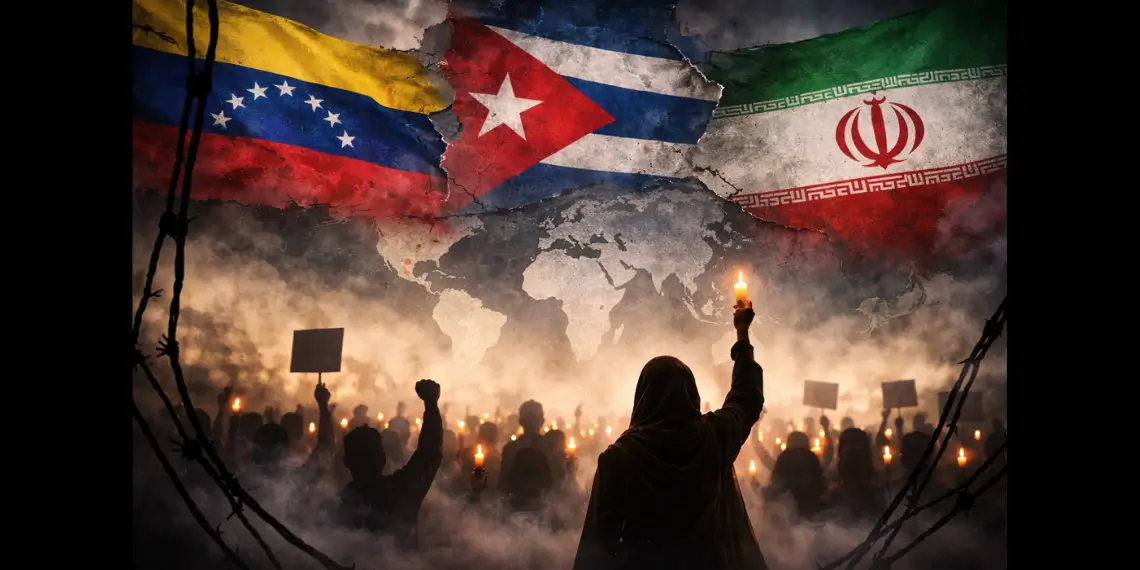
When it comes to Venezuela, Cuba, and Iran, I see entrenched systems that have suppressed dissent, crushed opposition, and in documented instances, overseen the killing of their own citizens.
Call it controversial. I call it confronting entrenched repression.
Not because Trump is righteous. Not because America is pure. But because sustained injustice cannot be romanticized simply because it cloaks itself in sovereignty.
Venezuela’s Collapse and the Cost of Repression
In Venezuela, what began under Hugo Chávez and hardened under Nicolás Maduro evolved into a state apparatus that has been accused by international investigators of extrajudicial killings during security operations. Anti-crime campaigns in poor communities reportedly left thousands dead over the years, with families alleging summary executions rather than lawful arrests. Protest crackdowns have resulted in fatalities. Political prisoners have reported torture and abuse.
Hyperinflation obliterated savings. Hospitals lacked basic supplies. Malnutrition rose. More than seven million Venezuelans fled, one of the largest displacement crises in the world. The suffering was not theoretical. It was visible in mass graves, in overcrowded prisons, and along migration routes.
Cuba’s Quiet Authoritarianism and Generational Harm
In Cuba, since the revolution led by Fidel Castro, the state has maintained tight control over political life. While Cuba does not experience mass killings in the same visible way as open conflict zones, history includes firing squads in the early revolutionary years, deaths in detention, and a long record of imprisoning dissidents. The July 2021 protests were met with force, arrests, and lengthy sentences. Families described beatings and harsh prison conditions.
Chronic shortages of food, medicine, and electricity compound political repression. When a state denies both political freedom and basic material stability, the harm is cumulative. It erodes dignity over generations.
Iran’s Crackdowns Show Why Confronting Repression Matters
In Iran, the pattern is even more stark. During periods of unrest, including protests in 2009, 2019, and following the death of Mahsa Amini in 2022, security forces were reported to have used lethal force against demonstrators. Human rights organizations have documented deaths during crackdowns and mass arrests. Iran also carries out executions at one of the highest rates globally. Protesters, activists, and minorities have faced imprisonment, and in some cases, death sentences after expedited proceedings.
These are not social media exaggerations. They are patterns documented over time by international observers, journalists, and advocacy groups. They reflect governments willing to use lethal force to maintain control.
So when I say I see something resembling the Lord’s work in confronting these regimes, I am not speaking about blind loyalty to a politician. I am speaking about the moral reality that governments that jail, torture, and kill their own citizens cannot be insulated from global consequences forever.
Sovereignty is not a license to brutalize. A national anthem does not wash away blood. A border does not sanctify repression.
Yes, pressure and confrontation carry risk. Yes, sanctions can strain civilian populations. Those concerns must be acknowledged honestly. But so must the reality that in these countries, civilians were already paying with their lives, their freedom, and their futures long before foreign pressure intensified.
There is a moral tension here. The world can choose cautious diplomacy that preserves stability on paper while repression continues. Or it can accept that entrenched authoritarian systems sometimes require external pressure to crack.
God has never relied on perfect instruments to disrupt hardened powers. History is filled with flawed leaders who nonetheless became catalysts for the fall of oppressive structures. That does not make every tactic holy. It does not make every consequence just. But it does remind us that disruption of entrenched injustice is often messy.
Freedom is not a Western invention. It is a human cry. The right to live without fear of being shot in the street for protesting. The right to speak without vanishing into a cell. The right to choose leadership without it being predetermined.
If challenging governments accused of killing their own citizens unsettles the global order, perhaps that order was too comfortable with silence.
History will judge outcomes. But I will not pretend that confronting regimes with documented patterns of lethal repression is immoral simply because it is controversial.
Sometimes, the shaking of hardened systems is the only path to exposing what has long been buried.