










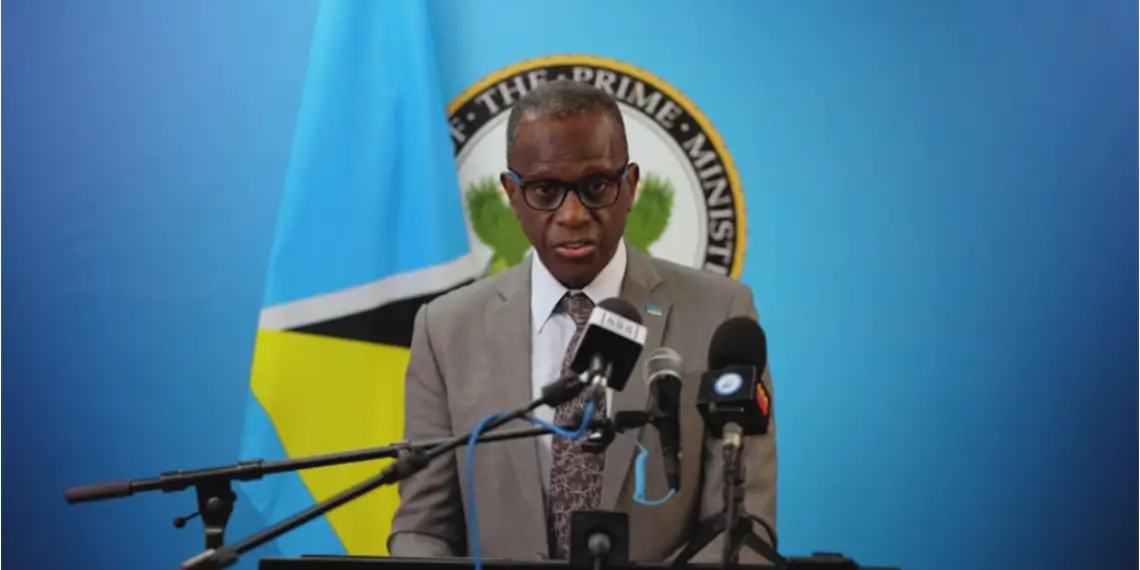
CASTRIES, St Lucia — Prime Minister Philip J. Pierre says the St Lucia CIP Programme will remain in place despite Britain’s decision to revoke visa-free access for Saint Lucian nationals, signaling that the government intends to strengthen the investment citizenship scheme rather than abandon it.
Speaking Monday, Pierre defended the programme as part of the country’s economic strategy while acknowledging concerns raised by the United Kingdom about risks linked to citizenship-by-investment initiatives. The UK recently imposed visa requirements on Saint Lucian travelers, citing immigration and security concerns connected to such programmes.
Pierre argued that, just as the United Kingdom has the authority to determine its immigration policies, Saint Lucia also has the sovereign right to pursue policies that support national development.
“I will tell you that Saint Lucia has no intention of stopping the CIP programme. We will do all we can. I want to be clear. We will do all we can to strengthen the programme,” the prime minister said.
UK flags risks linked to St Lucia CIP Programme
Concerns surrounding the St Lucia CIP Programme were outlined in the UK Home Office’s Explanatory Memorandum accompanying the Statement of Changes in the Immigration Rules, identified as HC 1691.
In section 5.24 of the document, citizenship-by-investment programmes are described as “inherently high-risk.” British authorities said that while the Saint Lucian government had taken steps over the past year to reduce vulnerabilities, they continue to face what the memorandum described as “unsustainable risks.”
According to the document, the increase in annual applications under the programme coincided with cases where individuals holding Saint Lucian passports later entered the United Kingdom and either claimed asylum or were found working illegally.
The memorandum did not provide specific numerical data detailing the scale of those incidents, but the concerns formed part of the rationale for the UK’s policy shift.
Britain’s move effectively ends the long-standing visa-free travel arrangement that previously allowed Saint Lucians to visit the UK for short stays without applying for a visa.
Pierre urges travelers to respect immigration rules
Pierre said correspondence delivered through the British High Commission indicated that rising asylum claims by Saint Lucian nationals were also a major concern raised by UK authorities.
He used the opportunity to urge citizens traveling abroad to comply with visa conditions and immigration rules, warning that overstaying can have wider consequences for the country.
“I want to say again, again to Saint Lucia nationals, even when they get a visa to go to the U.K. or to the U.S., do not overstay your time,” Pierre said.
“This is something we can control. Do not overstay your time when you get to the U.K. or the U.S. That is the main reason, as written in the letter.”
The appeal reflects growing concern among governments that immigration violations by travelers can trigger diplomatic and policy responses affecting entire populations.
Immigration crackdown adds pressure on investment programmes
The United Kingdom’s decision comes amid broader efforts by British authorities to tighten immigration controls and reduce net migration.
In recent years, Western governments have intensified scrutiny of so-called “golden passport” programmes across the Caribbean and Europe, citing concerns about security screening, transparency and the potential misuse of newly acquired citizenship.
Several Caribbean nations operate citizenship-by-investment programmes that generate significant revenue for national development and public projects. For small island states with limited economic options, such initiatives have become an important source of government income.
For Saint Lucia, the St Lucia CIP Programme remains a central part of its economic policy, even as international partners increase oversight of the model.
The immediate impact of Britain’s decision will be felt by ordinary travelers. Saint Lucians who previously entered the United Kingdom without a visa must now apply for permission before visiting, adding new administrative steps and potential costs for tourism, family travel and business trips.
As diplomatic discussions continue, the government faces the challenge of defending a programme it views as economically valuable while addressing concerns raised by one of its longstanding international partners.








St. Lucian government from both political parties mindset for decades have been to put all the island’s economic lifeline eggs in one basket. Be it the Sugarcane, Bananas, or the Tourist industries. Their failures to attempt and try new economies are coming to bite the population. Considering this small Caribbean nation known to be education focus, the question remains why has more emphasis not been made to get a bite of the High-tech Industry? I am of the opinion Data Centers would be a good start.