














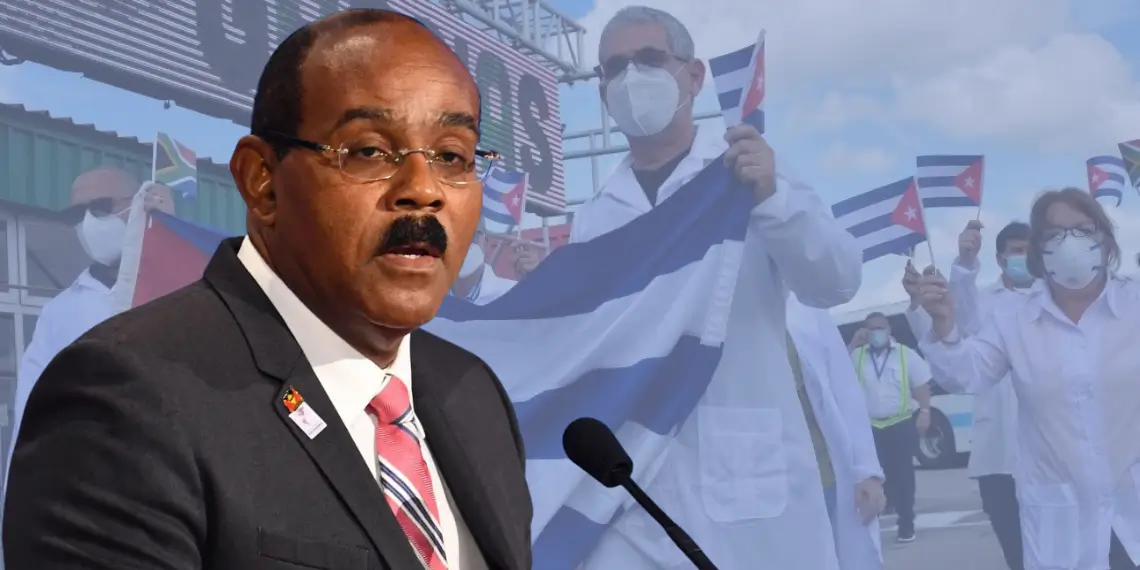
Silence follows as Gaston Browne ends Cuban medical program
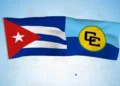
ST. JOHN’S, Antigua and Barbuda — Prime Minister Gaston Browne has ended Antigua and Barbuda’s long-standing Cuban medical program, allowing the final group of Cuban doctors and nurses to depart in December, despite having publicly defended the partnership earlier this year as fundamental to Caribbean healthcare.
The termination of the decades-old medical cooperation agreement was carried out without a formal public announcement. The government has not explained why the Cuban Medical Brigade was ended, how many medical professionals were affected, which clinics relied on their services, or how the resulting gaps in care will be filled. The lack of transparency has intensified public concern about the stability of the healthcare system and whether diplomatic pressure from the United States influenced the decision.
Public confirmation of the Cuban doctors’ departure came instead from the opposition United Progressive Party, which issued a statement on Dec. 19 expressing gratitude to the departing medical professionals. The opposition highlighted the loss of key services, including an eye-care program, it said brought relief to hundreds of citizens. The government, which made the decision to end the partnership, has issued no statement acknowledging the departure or outlining a transition plan.
From defiance to retreat
The silence surrounding the program’s termination stands in stark contrast to Browne’s vocal defense of Cuban medical missions earlier in 2025. In March, speaking on regional radio, the prime minister rejected U.S. allegations that Caribbean countries hosting Cuban doctors were complicit in human trafficking. He said Cuban doctors and nurses represented the core of healthcare delivery across the region and warned that visa-related pressure threatened to dismantle Caribbean health systems.
That pressure escalated in the months that followed. By September, the United States intensified scrutiny of countries maintaining Cuban medical partnerships, with U.S. Secretary of State Marco Rubio publicly supporting visa restrictions tied to the issue. Antigua and Barbuda responded by restructuring payment arrangements so Cuban doctors would receive their full salaries directly, rather than through Havana. Government officials said the changes were intended to satisfy Washington while preserving a partnership the country valued.
The effort failed. By December, the Cuban medical professionals had departed, and the Browne administration’s earlier assurances of unwavering support gave way to complete silence.
The development mirrors a broader pattern of U.S. visa enforcement across the region and beyond. Washington has increasingly relied on visa restrictions as a diplomatic tool, as outlined in a separate Unitedpac St Lucia News report on how the United States imposed visa bans on Central American officials amid governance and policy disputes, underscoring the leverage such measures carry in international relations.
Healthcare questions mount
The government’s failure to address the issue publicly has left a cascade of unanswered questions. It remains unclear how many Cuban doctors and nurses were working in Antigua and Barbuda, which facilities are now operating short-staffed, and whether specialist services have been reduced or suspended.
There is also uncertainty surrounding Antiguan students studying medicine in Cuba under bilateral educational agreements. The administration has not clarified whether those arrangements will continue following the termination of the medical partnership.
The timing has drawn particular scrutiny as Antigua and Barbuda prepares to launch a National Health Insurance system in 2026. Health observers warn that staffing shortages could undermine the initiative before it begins if replacement personnel are not secured.
Ghana option remains unresolved
For several years, Antigua and Barbuda has explored recruiting healthcare workers from Ghana as an alternative. Cabinet records from 2022 indicated that the Ministry of Health had begun efforts to attract Ghanaian nurses, following Barbados’s successful recruitment of hundreds of Ghanaian medical professionals.
Three years later, there has been no public update on whether Ghanaian healthcare workers will replace the Cuban doctors and nurses, how many are expected, or when they might arrive. The government has also not disclosed which specialties would be prioritized, leaving continued uncertainty across the healthcare system.
Regional implications
The decision carries broader implications for the Caribbean. Throughout much of 2025, leaders of the CARICOM bloc publicly defended Cuban medical cooperation and called for dialogue with U.S. officials over visa-related threats. Antigua and Barbuda’s quiet withdrawal highlights the limits of regional unity when diplomatic pressure intensifies.
Domestically, the opposition has seized on the issue as a matter of accountability. By publicly thanking Cuba while the government remained silent, the United Progressive Party has positioned itself as the defender of a partnership it says delivered measurable benefits to citizens.
As clinics adjust to the absence of Cuban medical staff and patients seek clarity on available services, pressure is mounting on the Browne administration to explain why a program it once described as fundamental was ended without public justification, and how healthcare delivery will be safeguarded going forward.
Continue following Unitedpac St Lucia News for further updates on this developing story and other major Caribbean and international issues.