












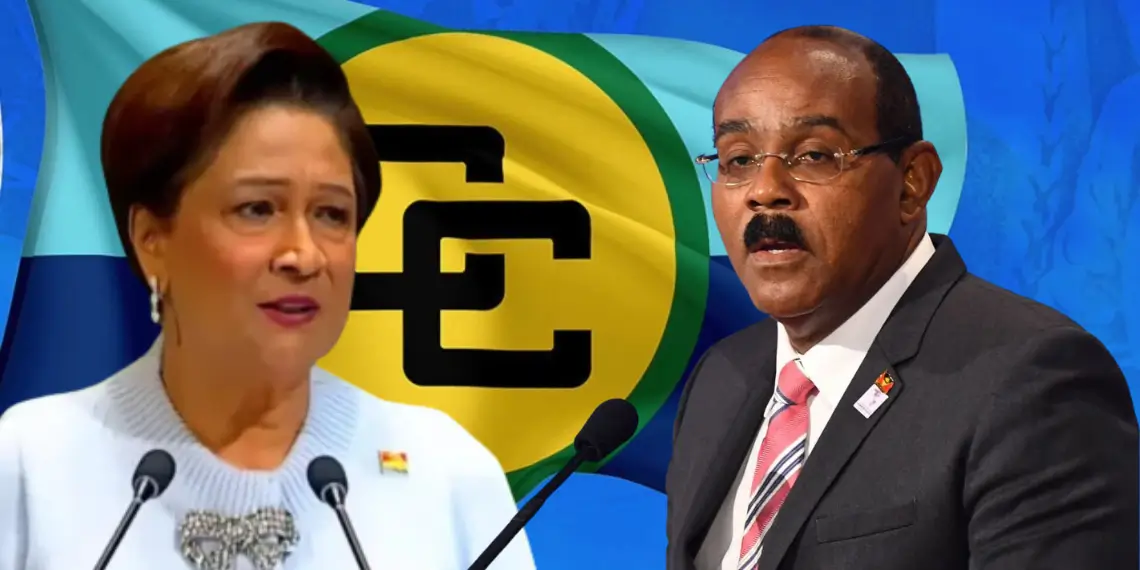
Trinidad and Tobago PM defends foreign policy stance amid backlash from Caricom leaders
PORT OF SPAIN, Trinidad and Tobago — Kamla rejects Caricom zone of peace arguments once again, with Prime Minister Kamla Persad-Bissessar distancing Trinidad and Tobago from the regional bloc’s security posture and accusing the Caribbean Community of aligning with Venezuela’s authoritarian government, a position she said runs counter to her country’s national interests.
Speaking to Guardian Media, Persad-Bissessar said Trinidad and Tobago would not associate itself with what she described as a dangerous and misleading regional narrative. She accused the Caribbean Community of supporting Venezuelan President Nicolás Maduro, whom she characterized as presiding over widespread political repression, imprisonment of opponents, and state-enabled criminal activity. Her comments echo long-standing concerns about Caricom’s dysfunction and internal fractures, which have increasingly come under public scrutiny across the region.
“Trinidad and Tobago wants no part of that alignment,” Persad-Bissessar said, adding that her administration does not support dictatorship, drug trafficking, or what she described as Caricom’s fabricated zone of peace narrative.
Her comments have intensified an already heated regional exchange, following public criticism from Antigua and Barbuda Prime Minister Gaston Browne, who took issue with her decision to distance Trinidad and Tobago from a recent Caricom Bureau statement expressing concern over United States visa restrictions imposed on some Caribbean nationals.
Persad-Bissessar responded by urging Browne and Antigua and Barbuda’s ambassador to the United States, Sir Ronald Sanders, to focus on explaining the visa developments to their own citizens rather than challenging her foreign policy decisions.
She also raised renewed concerns about Venezuela’s territorial rhetoric, noting that Caracas has long threatened Guyana and, since mid-2024, has begun making similar claims involving Trinidad and Tobago.
Despite these developments, Persad-Bissessar said Caricom continues to promote the zone of peace narrative, which she argued is designed to encourage the withdrawal of United States military influence from the Caribbean. Such a move, she warned, would only strengthen Maduro’s hold on power.
The Prime Minister stressed that her position is driven by national interest rather than regional political pressure.
“My responsibility is to the citizens of Trinidad and Tobago,” she said. “That is where my mandate lies.”
Browne defends Caricom trade and security record
Browne rejected Persad-Bissessar’s assertion that Caricom has become an unreliable partner, emphasizing that Antigua and Barbuda respects the sovereign right of each member state to conduct its own bilateral relations.
“No member should question the legitimacy of another Caricom state engaging responsibly and transparently with international partners, including the United States,” Browne said in a Facebook post.
He also defended Caricom’s economic value to Trinidad and Tobago, citing trade data showing that the country earned more than US$1.1 billion in foreign exchange from Caricom trade in 2024. That figure included approximately US$784.7 million in domestic exports and US$501.3 million in re-exports, making Caricom Trinidad and Tobago’s second-largest export market after the United States.
Browne noted that Trinidad and Tobago has consistently recorded the largest merchandise trade surplus within Caricom and remains the only member state to maintain a net positive trade balance with the bloc since its establishment in 1973.
He further argued that Caricom’s importance extends beyond trade, pointing to regional security cooperation, intelligence sharing, and coordinated law enforcement efforts as critical tools in combating organized crime.
Browne also dismissed claims that Antigua and Barbuda’s leadership had spoken negatively about the United States, stating that no evidence exists to support such allegations.
Political backlash at home
Former prime minister Keith Rowley sharply criticized Persad-Bissessar’s remarks, warning that her stance risks isolating Trinidad and Tobago and undermining regional unity.
In a social media post, Rowley accused the Prime Minister of recklessness and claimed her comments reduced the country’s standing in international affairs. He further alleged that her administration was signaling to citizens that maintaining access to United States visas required compliance with external expectations.
Public Utilities Minister Barry Padarath responded by defending Persad-Bissessar’s approach, accusing the former administration of using Caricom to advance narrow political interests.
Padarath said the Prime Minister is redefining foreign policy in a way that prioritizes national and economic security, while rejecting what he described as the illusion that the Caribbean functions as a genuine zone of peace amid persistent gun trafficking, drug trafficking, and human trafficking.
Analysts urge caution
Regional and international affairs analysts warned that the Prime Minister’s rhetoric could have lasting diplomatic consequences. Anthony Bryan, professor emeritus of international relations at the University of Miami, said the claim that Caricom is unreliable is unjustified and risky for a small state.
“Caricom provides flexibility for member states and does not impose a single foreign policy,” Bryan said, warning that turning away from the bloc could leave Trinidad and Tobago vulnerable.
Political scientist Derek Ramsamooj urged restraint, cautioning that sharp rhetoric could damage the regional project. He said the consequences of such decisions would ultimately be borne by citizens rather than political leaders.
Dr Indira Rampersad said the controversy highlights a long-standing tension between nationalism and regionalism within Caricom. She noted that the bloc has struggled with implementation failures under the Revised Treaty of Chaguaramas, particularly on free movement provisions.
Rampersad described Persad-Bissessar’s stance as politically pragmatic, emphasizing that leaders are elected by domestic constituencies, not regional institutions. She also pointed to the dominant influence of the United States as Trinidad and Tobago’s largest trading partner, framing alignment with Washington as a calculated strategic choice.
CADRES director Peter Wickham, however, criticized the Prime Minister’s tone as undiplomatic, arguing that Trinidad and Tobago, as a leading Caricom member, should focus on reforming the institution rather than publicly undermining it.
The escalating dispute has also reignited a broader regional debate over Caricom’s direction and credibility. Critics are increasingly asking whether the bloc has drifted away from its founding principles and become dominated by a small circle of entrenched regional leaders, driven by rigid ideological alignment and insulated networks within Caribbean academic and political institutions. The question now being raised across the region is whether Caricom still serves the collective interests of Caribbean people, or whether it has evolved into an insular power structure that benefits from and shields relationships with Venezuela’s troubled and corruption-tainted regime.
For continued coverage of Caribbean politics and regional diplomacy, follow Unitedpac St Lucia News for more breaking developments.










Peter Wickham is one of the termites whose involvement with some political leaders has contributed to the leftwards drift of some islands towards communism and dictatorship. He works closely with Dominica government and hasn’t seen it fit to stand up against the shame that Dominica has suffered over the recent years. He has to support the goose which lays the golden egg he has been harvesting. Kamla is right to focus on what’s best for her country and it’s democratic and just. Peter is in support of the quasi dictatorships which waters down the rule of law. The OECS is wrong to support Maduro whilst leaning into the RSS to trample the rights of citizens in the sub-region to exercise their rights to protest. Gaston doesn’t speak for the majority of the people in the region. A crisis is a terrible thing to waste so let the leaders come together and get it straight once again that when a major member like Trinidad has issues they must be addressed over what Maduro wants. If not then let the paper agreement collect dust. Zone of peace whilst Maduro threatening Trinidad and Guyana and the leaches are declared zone of peace nonsense. China won’t step into this void to prevent America from doing what it feels it must to safeguard it’s interests. The employees in the CARICOM secretariat need to be replaced because they have failed the leaders and the people by not giving sound guidance for lasting peace among member states.