


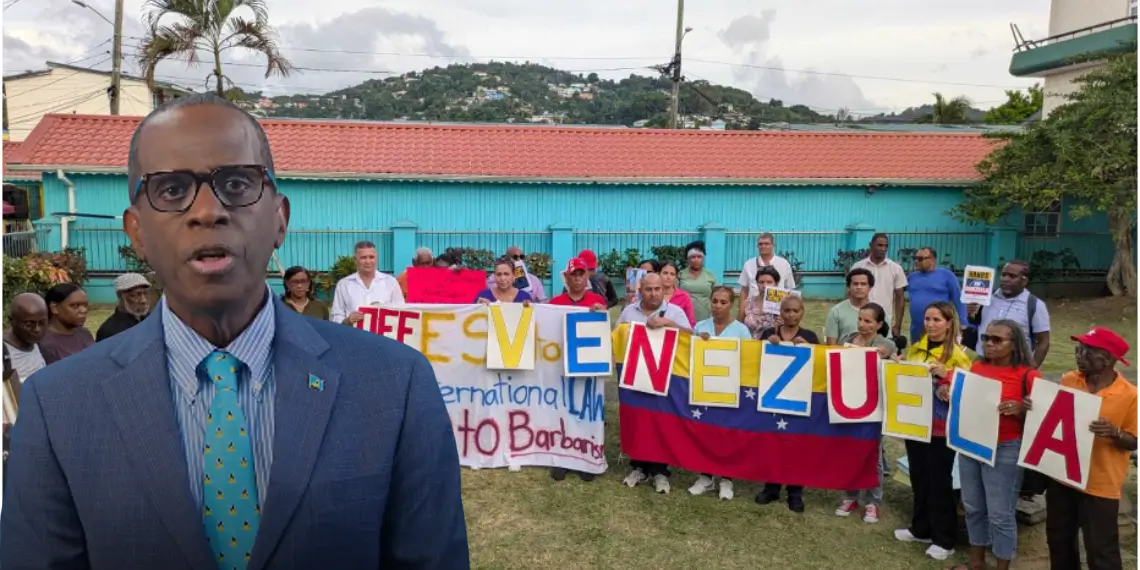
Political silence deepens as SLP government sends proxies
CASTRIES, St Lucia — The St Lucia Labour Party government has chosen silence at the highest level on the escalating crisis in Venezuela, even as a small group of its supporters took to the streets of Castries this week to denounce United States actions, a contrast that critics say exposes a deliberate strategy of proxy politics and a reluctance by Prime Minister Philip J. Pierre to publicly declare his administration’s position.
On Tuesday afternoon, a placard-bearing group gathered at Bideau Park chanting “Viva Venezuela, Viva Cuba, Viva Santa Lucia” at a pro-Venezuela rally organized by the interim Saint Lucia/Venezuela Association. Speakers condemned Washington’s actions and framed the demonstration as a show of solidarity with Caracas and a defense of the Caribbean as a zone of peace.
Absent from the scene, however, was any official voice of government.
No Cabinet minister addressed the crowd. No statement was issued by the Office of the Prime Minister. No formal policy position was articulated to the nation or to international partners. Instead, partisan supporters and sympathetic activists carried the message, leaving the government insulated from direct accountability while its political allies filled the vacuum.
Political observers say the optics were unmistakable. At a moment when foreign policy decisions carry implications for trade, security cooperation, visas and diplomatic relations, the Philip J Pierre administration has opted not to speak, allowing aligned groups to do the talking.
Symbolism at the rally was heavy. Bideau Park is named after Saint Lucian-born sea captain Jean Baptiste Bideau, remembered for saving South American liberator Simón Bolívar from drowning and for his commitment to anti-colonial struggle. Busts of Bolívar and Bideau overlook the park, lending historical gravitas to the event.
Venezuelan Ambassador Leiff Escalona thanked those in attendance, including Cuban Ambassador Yenielys Linares and members of Cuba’s medical brigade. Escalona said she had received calls from Saint Lucians expressing solidarity after reports of US military action in Venezuela and described the rally as an important public expression of support.
“This is an expression of solidarity by the people and the solidarity movement in Saint Lucia, supporting Venezuela,” Escalona told the gathering.
Trevor Heath, head of the interim Saint Lucia/Venezuela Association, delivered a prepared statement sharply critical of Washington, describing US actions as “barbaric” and warning that unopposed intervention could set a dangerous precedent for the region.
“If this is allowed to happen, it could happen to any country,” Heath said, condemning what he described as efforts to effect regime change in Venezuela and the militarization of Caribbean waters.
Cuban Ambassador Linares echoed those sentiments, calling the January 3 incident “illegal and irrational” and urging that Latin America and the Caribbean remain a zone of peace. She questioned who had the authority to intervene militarily and warned that other nations could be targeted next.
Veteran journalist and commentator Earl Bousquet placed the developments in a broader historical context, citing past US interventions in Grenada, Panama and Haiti. He argued that Venezuela’s experience should alarm small states across the region.
“That it happened to them means it can happen to us,” Bousquet said, asserting that the United States has a long record of military involvement in Latin America and the Caribbean.
Bousquet also accused Washington of pursuing strategic and economic interests, including oil, and warned that regional solidarity must be backed by personal sacrifice and vigilance.
Yet while speakers at Bideau Park spoke forcefully, the silence from the SLP government itself has become the central issue at home.
Critics argue that the Pierre administration cannot plausibly claim neutrality while its supporters publicly advance a one-sided narrative. They say foreign policy by proxy undermines transparency and weakens Saint Lucia’s credibility, particularly with international partners who expect clarity from elected leaders, not partisan intermediaries.
Diplomatic analysts note that Saint Lucia established relations with Venezuela in 1979 and has historically balanced those ties with its longstanding relationship with the United States. That balance, they say, traditionally requires careful, public articulation of policy, especially during periods of heightened tension.
Instead, the government’s approach has left citizens guessing. Is the SLP administration aligned with the rhetoric voiced at the rally, or is it distancing itself while quietly benefiting from the political signaling? Without an official statement, the question remains unanswered.
Opposition voices and civil society figures say the moment calls for leadership, not silence. They argue that the prime minister owes the country a clear explanation of where Saint Lucia stands, how it intends to safeguard national interests, and whether the views expressed by government supporters reflect official policy or partisan theater.
As geopolitical tensions intensify across the Caribbean and Latin America, the cost of ambiguity is rising. For now, the SLP government’s decision to avoid a direct Venezuela stance while allowing proxies to speak has only sharpened scrutiny at home and abroad.
For continued coverage and accountability reporting on St Lucia and regional geopolitics, continue following Unitedpac St Lucia News for more breaking news.