
















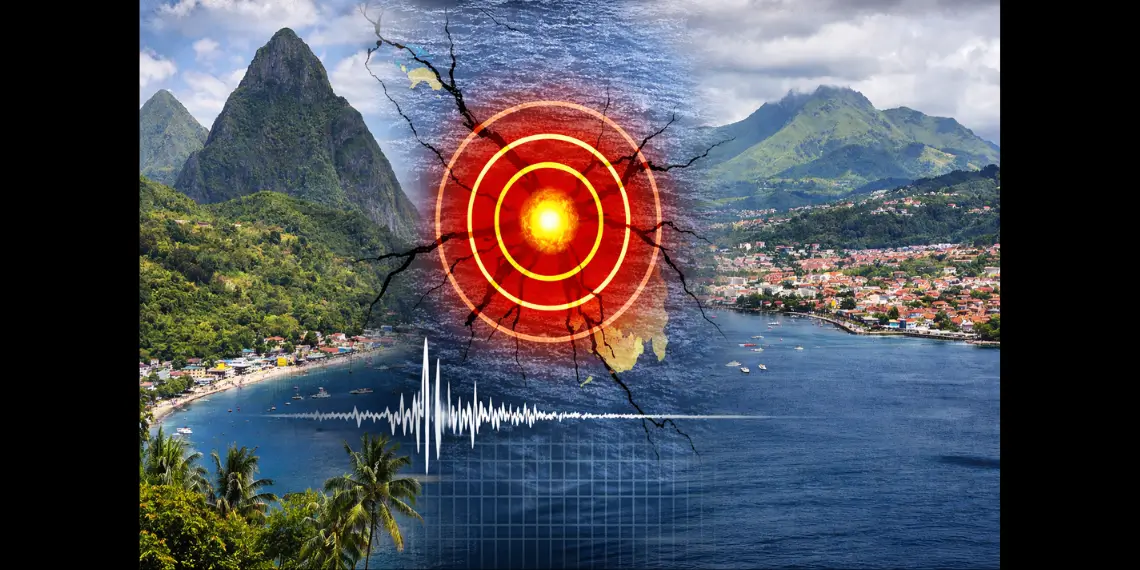
Tremors felt across the island as St Lucia rattled by 5.5 earthquake
CASTRIES, St Lucia — A strong magnitude 5.5 earthquake struck the eastern Caribbean on Friday afternoon, sending tremors across St Lucia and neighboring islands after originating offshore near Fort-de-France, Martinique.
The quake occurred at 5:48 p.m. local time (GMT-4) on Friday, Jan. 2, 2026, and was centered approximately 78 kilometers (48 miles) from Fort-de-France, according to preliminary seismic data. Scientists reported the earthquake had a depth of about 56 kilometers (35 miles), classifying it as relatively shallow and contributing to the widespread shaking experienced across the region.
Seismic details of the earthquake were published by the United States Geological Survey, which monitors global earthquake activity.
Residents across multiple districts in St Lucia reported feeling the tremor as a rolling motion that lasted several seconds. In some areas, household items rattled and light fixtures swayed briefly before the shaking subsided. The earthquake was felt in both northern and southern parts of the island, reflecting the reach of the seismic waves generated by the event.
As of Friday evening, there were no immediate reports of injuries or significant damage in St Lucia. Local authorities said they were monitoring the situation and advised residents to remain attentive to official updates. No disruptions to electricity, water supply, or telecommunications were reported in the hours following the quake.
In Martinique, where the epicenter was located offshore, the earthquake was also strongly felt, particularly in and around Fort-de-France. Initial assessments from the French territory indicated that residents experienced noticeable shaking, but early reports did not point to widespread structural damage. Authorities there activated routine post-earthquake monitoring procedures to assess public buildings and infrastructure.
Seismologists noted that earthquakes occurring at shallow depths are typically felt more intensely near the epicenter than deeper events of similar magnitude. Because less energy is lost before reaching the surface, ground motion can be stronger and more widely perceived, even when the epicenter is offshore. This characteristic explains why Friday’s earthquake was felt across a broad area of the eastern Caribbean.
The eastern Caribbean lies along the boundary between the North American Plate and the Caribbean Plate, making the region prone to seismic activity. The Lesser Antilles island chain, which includes St Lucia and Martinique, experiences regular earthquakes ranging from minor tremors to moderate and occasionally stronger events. Most of these earthquakes do not result in serious damage but are often felt by residents across several islands.
While the magnitude 5.5 earthquake prompted concern among residents, experts emphasized that such events are not uncommon in the region. Earthquakes of this size can be alarming due to their suddenness and the sensation of movement, particularly in areas with dense populations or multi-story buildings.
No tsunami advisories were issued following the quake, and scientists indicated that earthquakes of this magnitude and depth in the eastern Caribbean are unlikely to generate tsunamis. Nevertheless, coastal residents were encouraged to stay informed through official channels and to follow guidance from local disaster management agencies.
Emergency management officials in St Lucia reiterated general earthquake safety advice, including remaining calm during shaking, avoiding hazardous areas immediately afterward, and checking for potential hazards inside homes such as unsecured furniture or damaged utilities. Residents were also reminded that aftershocks can occur following a main earthquake, although these are usually smaller in magnitude.
Across the region, social media users shared brief accounts of their experiences as the tremor passed, with many describing a sudden but short-lived shaking. While such accounts reflected the reach of the earthquake, authorities cautioned against relying on unofficial reports and encouraged the public to seek information from credible and official sources.
Seismic monitoring agencies continue to analyze data from Friday’s earthquake to refine details about its location and characteristics. Any updated information will be released as it becomes available.
Unitedpac St Lucia News will continue to monitor developments and provide timely updates on this and other breaking stories affecting St Lucia and the wider Caribbean.