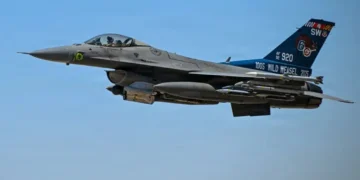














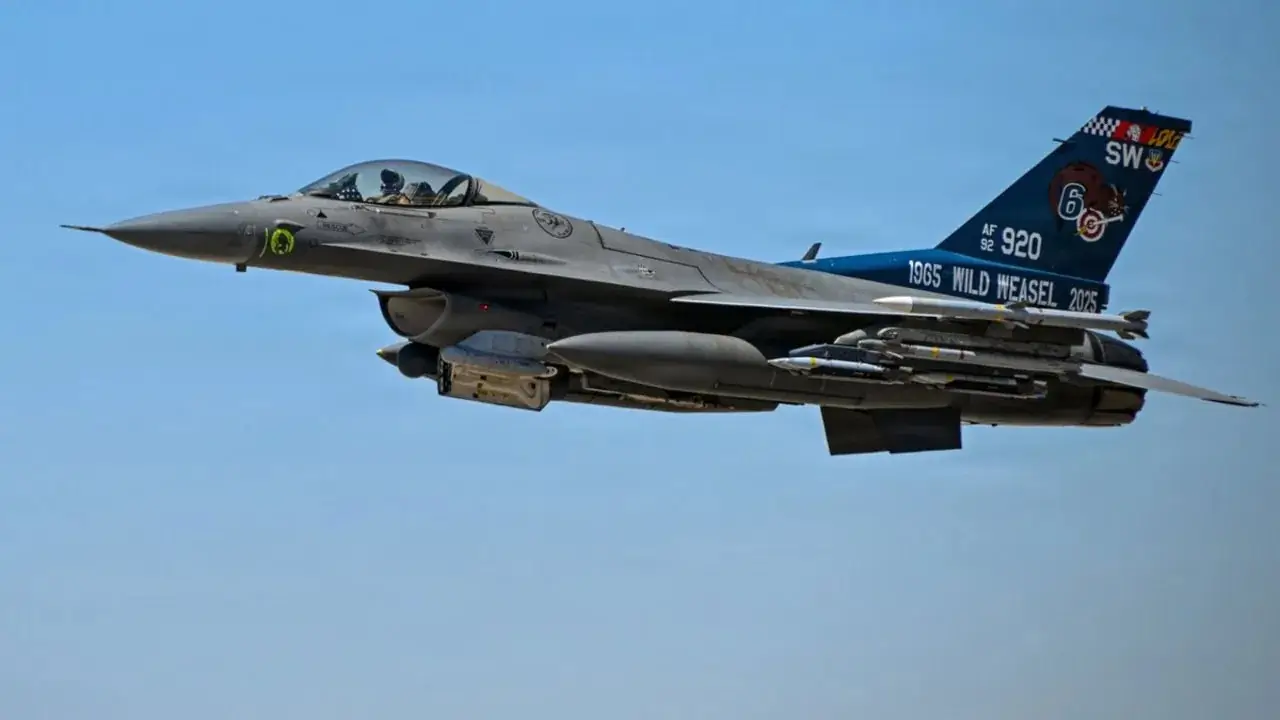
PERSIAN GULF — Iran’s army said Saturday that one of its missiles exploded near a US F-16 fighter jet over the Persian Gulf on Friday evening, damaging the aircraft and forcing its pilot to make an emergency landing. US Central Command denied that Iran attacked the jet and said all American military fighter jets in the Middle East were safe and accounted for.
Iran’s army says US F-16 abandoned its mission
The account came from the public relations office of Iran’s regular army, known as the Artesh, according to Iran’s semi-official Tasnim news agency. The army said its air defense force detected the fighter jet over the Gulf and fired a missile that detonated near the aircraft. It said the resulting damage forced the pilot to cut short the mission and land at a nearby airport.
The army’s account described an explosion near the jet and left the landing site unnamed. The alleged missile attack, damage to the aircraft and emergency landing have not been independently verified.
US Central Command rejects the allegation
In a statement posted Saturday, US Central Command called the allegation false and said Iran had not attacked a US F-16 on Friday. The command also said every US military fighter jet in the Middle East was safe and accounted for.
The command attributed the allegation to the Islamic Revolutionary Guard Corps. Tasnim identified the regular army’s public relations office as the source of the Iranian account. The regular army and the Revolutionary Guard are separate branches of Iran’s armed forces.
Iran has made other claims during the war that it shot down or damaged US aircraft, and the US military has disputed those accounts, Reuters reported. Earlier in November, US officials said American forces carried out strikes on Iranian air defenses on Qeshm Island, near the Strait of Hormuz. Those strikes were a separate episode in the conflict.
Qatar keeps talks open as Gulf shipping remains disrupted
The dispute emerged as Qatar continued mediating between Washington and Tehran. Iranian Deputy Foreign Minister Kazem Gharibabadi said a Qatari delegation held talks in Tehran on Friday night. He told Tasnim that Iranian officials remained in contact with mediators, including Qatar, to see whether diplomacy could resume.
The visit followed Qatar’s earlier efforts to restart US-Iran negotiations. Qatar’s prime minister met President Donald Trump at the White House on Nov. 9 after visiting Tehran the previous week. After that meeting, Trump said he would hold off on fresh strikes for the time being and keep the US naval blockade of Iranian ports in place.
Washington and Tehran reached a memorandum of understanding in June that led to a brief ceasefire and included provisions on the Strait of Hormuz and Iran’s nuclear program. Subsequent talks have stalled over the order in which the two sides would carry out proposed steps, Reuters reported. Iran has tied the restoration of normal shipping through the strait to concessions from Washington.
The war began Feb. 28 with US and Israeli strikes on Iran. Tehran retaliated with attacks on Israel and Gulf countries that host US military bases. The fighting disrupted shipments through the Strait of Hormuz, which connects the Persian Gulf to the Gulf of Oman and carries oil and liquefied natural gas exports to world markets.
Oil flows through the strait averaged 9.1 million barrels a day in the third quarter, up from 5.1 million in the second quarter but still less than half the 21.4 million recorded in the same period a year earlier, according to the US Energy Information Administration. The figures show how far shipments remained below prewar levels even after traffic began to recover.
Iranian Foreign Minister Abbas Araqchi told the state-owned Iran newspaper that Tehran still hoped diplomacy could end the war. Trump has said the terms Iran sought were unacceptable to him. No agreement was announced Saturday following the Qatari delegation’s visit.