













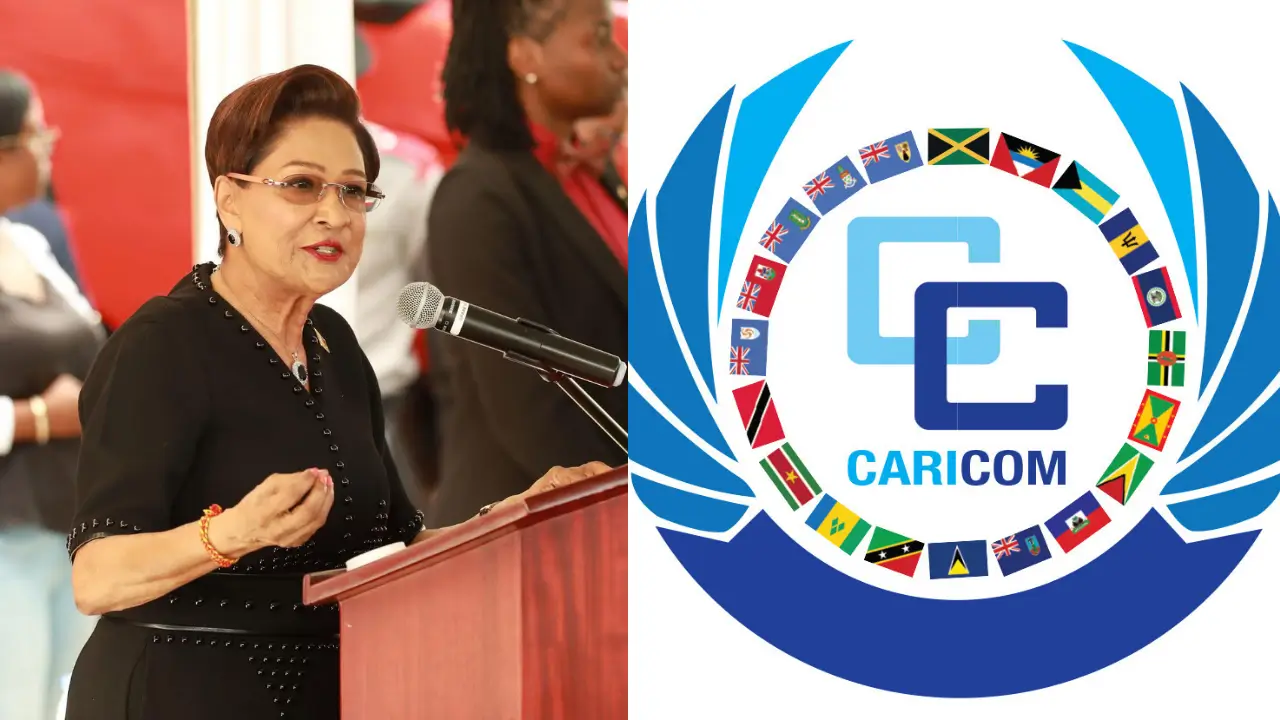
PORT OF SPAIN, Trinidad and Tobago — T&T defies Caricom over Carla Barnett’s reappointment, with Prime Minister Kamla Persad-Bissessar saying her government would not recognize Barnett as secretary-general for a second term despite support from other member states.
Asked in May whether CARICOM could expel Trinidad and Tobago over the dispute, Persad-Bissessar said the regional body was free to do so. She made clear, however, that her government was not announcing a withdrawal from CARICOM. Her responses to questions about the dispute were first reported by the Trinidad Express.
Trinidad and Tobago challenges the decision
CARICOM announced in March that the required majority of heads of government had agreed to reappoint Barnett during their February meeting in St. Kitts and Nevis. Her first term was due to end in August 2026.
Trinidad and Tobago objects to how the decision was reached. Foreign Affairs Minister Sean Sobers told Parliament that Barnett’s proposed reappointment was absent from the circulated agenda and was not discussed during a plenary session attended by Persad-Bissessar. He said his country was not invited to the meeting at which the reappointment decision was made.
Sobers argued that a decision taken without proper participation by member states would violate the Revised Treaty of Chaguaramas. That remains Trinidad and Tobago’s legal position, not an established finding that CARICOM breached the treaty.
The disagreement also centers on a retreat in Nevis. Sobers said he received a WhatsApp message on the morning of the retreat indicating that he should not attend. Persad-Bissessar later accused Barnett of drafting a statement issued under the name of then CARICOM Chairman Terrance Drew without addressing that message.
Persad-Bissessar said her government had requested meeting notes and other records to clarify what happened but had not received satisfactory answers. She accused CARICOM officials and foreign ministers of remaining silent despite what she said was evidence in the WhatsApp group. Those accusations are her account of the officials’ conduct.
Unitedpac St Lucia News previously reported on her demands for records and concerns about the Barnett reappointment process.
Later meeting fails to settle the dispute
The Trinidad Express reported that 10 leaders from CARICOM’s 15 member states attended a subsequent virtual meeting where the controversy was discussed. Trinidad and Tobago’s representatives objected to proceeding while Persad-Bissessar and Sobers were unavailable because of other official commitments.
A majority of those present supported allowing the reappointment to stand. Trinidad and Tobago maintained its opposition, leaving CARICOM’s decision and one member state’s rejection of the process at odds.
Persad-Bissessar also rejected the suggestion that her government should accept the outcome because other leaders supported Barnett. She said its position on recognizing Barnett for a second term would not change.
Prime minister addresses trade and membership
Persad-Bissessar said Trinidad and Tobago was seeking to expand trade with countries in the Middle East, South America, India and Africa. Her government, she said, was pursuing opportunities beyond the CARICOM market while continuing its participation in the regional body.
Asked about possible efforts by Jamaican Prime Minister Andrew Holness to help resolve the disagreement, Persad-Bissessar said she respected him but would not disclose details of their conversations.
She also said Trinidad and Tobago had continued to send representatives to CARICOM meetings, while repeating her objection to the WhatsApp message Sobers said he received before the Nevis retreat.
Pressed on whether the dispute could lead to expulsion, Persad-Bissessar said CARICOM could decide how to respond. Her remarks expressed defiance over Barnett’s reappointment, but she did not say Trinidad and Tobago intended to leave the organization.
CCJ Guidance Sought as T&T Defies Caricom
The dispute developed further after the original May report. At a July meeting in St Lucia, CARICOM leaders acknowledged Trinidad and Tobago’s continuing objection and agreed to seek an advisory opinion from the Caribbean Court of Justice on the reappointment process.
CARICOM said Barnett’s reappointment would remain in place unless and until the community considered the court’s opinion. In a July 17 advisory, the CCJ said it had not yet received an official request. That statement confirms the court’s position on July 17; it does not establish whether a request was filed afterward.
The proposed advisory opinion concerns the CCJ’s authority to interpret the CARICOM treaty. It is separate from the question of whether Trinidad and Tobago makes the CCJ its final court of appeal, an issue Persad-Bissessar raised when asked about taking the matter to court.
Barnett has continued to perform the secretary-general’s duties. The unresolved question is whether CARICOM followed the required process when it approved her second term.