











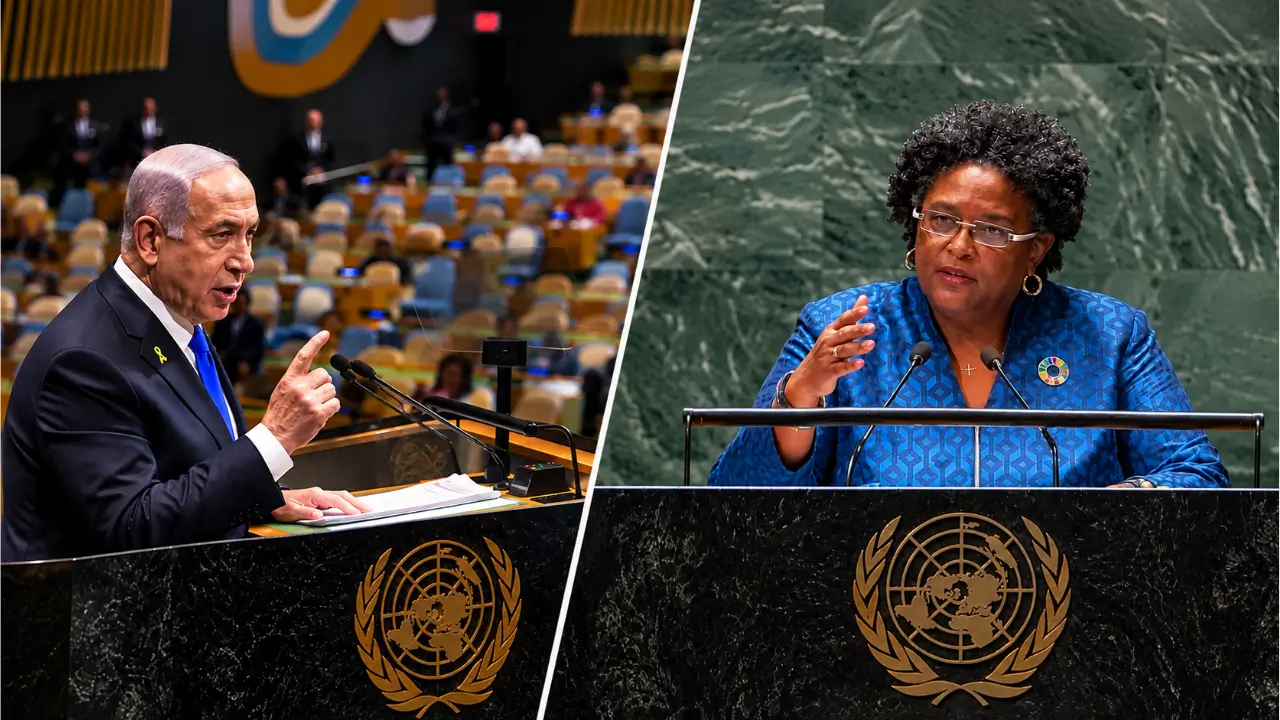
BRIDGETOWN, Barbados — Barbados has denied participating in the UN Walkout during Israeli Prime Minister Benjamin Netanyahu’s address, saying Prime Minister Mia Mottley and the country’s delegation remained inside the United Nations General Assembly hall as other diplomats left.
The denial challenges reports that included Barbados among Caribbean countries associated with the diplomatic protest and raises questions about some of the country-by-country accounts that emerged after the widely documented walkout.
Barbados Disputes UN Walkout Reports
The Prime Minister’s Office issued the clarification Sunday, three days after Netanyahu addressed the 81st session of the UN General Assembly in New York.
The PMO said the Barbados delegation, including Mottley, remained in place while finalizing the speech the prime minister delivered later Thursday afternoon.
The government pointed to Mottley’s subsequent address as setting out Barbados’ position on the current war and the wider Arab-Israeli conflict.
The clarification draws an important distinction between Barbados’ position on the conflict and whether its representatives participated in the protest against Netanyahu.
Barbados did not dispute that the broader walkout occurred. Instead, the government specifically rejected reports identifying its delegation as one of those that participated.
Walkout Greets Netanyahu at UN
The broader diplomatic protest unfolded as Netanyahu appeared before world leaders during the annual General Assembly gathering in New York.
Dozens of delegates left the chamber as the Israeli leader began his address, leaving sections of the General Assembly hall visibly empty.
The protest came amid intense international debate over Israel’s military operations and the continuing conflict in Gaza.
The spectacle of diplomats leaving the chamber became one of the most visible diplomatic protests surrounding Netanyahu’s appearance at the General Assembly.
Barbados’ objection is therefore not about whether the protest occurred. Its challenge is directed at reports that identified the country as a participant.
Mottley Sets Out Barbados’ UN Position
Mottley’s address later Thursday provides additional context to the government’s denial.
The Barbadian leader used her speech to address conflicts including Gaza, the West Bank, Lebanon, Yemen, Sudan and Ukraine while calling for changes in how the international community responds to prolonged crises.
Mottley maintained Barbados’ support for a two-state solution to the Israeli-Palestinian conflict, arguing that lasting stability requires recognition of the rights and territories of Israelis and Palestinians.
She also proposed the systematic deployment of small UN mediation teams involving current and former political leaders to intervene in conflicts before violence becomes further entrenched.
Her address went beyond individual conflicts to challenge the structure of the United Nations itself.
Mottley announced Barbados’ support for an initiative seeking restraint in the use of the UN Security Council veto in cases involving mass atrocities. She also renewed calls for permanent African representation on the Security Council and greater representation for small island developing states.
Those positions provide important context to the walkout dispute. Barbados’ government is not arguing that Mottley avoided addressing the issues surrounding the conflict. Rather, it says the country’s position was expressed through her address, not by leaving the General Assembly chamber during Netanyahu’s appearance.
Barbados Denial Adds Caribbean Context
The clarification also adds another layer to reporting surrounding Caribbean participation in the protest.
Early accounts identified Barbados alongside several regional countries among delegations reported to have walked out or been absent during Netanyahu’s address. The Barbados government is now explicitly rejecting its inclusion in those accounts.
Early reports also identified the St Lucia delegation as participating in the Netanyahu walkout, as questions emerged over which Caribbean countries joined the diplomatic protest.
Barbados’ subsequent denial does not establish whether reports involving St Lucia or other Caribbean countries were accurate. It does, however, underscore the difference between documenting a large-scale departure from the chamber and establishing which individual national delegations participated.
That distinction becomes particularly important when images of an unfolding diplomatic protest are used to determine the actions of individual countries. Empty seats or delegates moving through the chamber do not, by themselves, establish the position or actions of every national delegation.
Why Barbados’ Clarification Matters
The dispute is now less about whether a walkout occurred and more about the accuracy of reports identifying the countries involved.
Being identified as participating in a diplomatic walkout can carry significance beyond the event itself because such an action may be interpreted as a deliberate expression of a government’s foreign policy.
Barbados has drawn a clear distinction between its policy position and reports that its delegation demonstrated that position by leaving during Netanyahu’s address.
Mottley’s subsequent speech reinforced that distinction. She addressed the Israeli-Palestinian conflict directly, backed a two-state solution and called for broader changes to how the United Nations responds to international conflicts.
The government’s clarification therefore leaves the broader diplomatic protest undisputed while challenging Barbados’ inclusion among the participating countries.
For Barbados, the official position is explicit: Mottley and the country’s delegation remained inside the General Assembly hall as other diplomats walked out during Netanyahu’s appearance.