















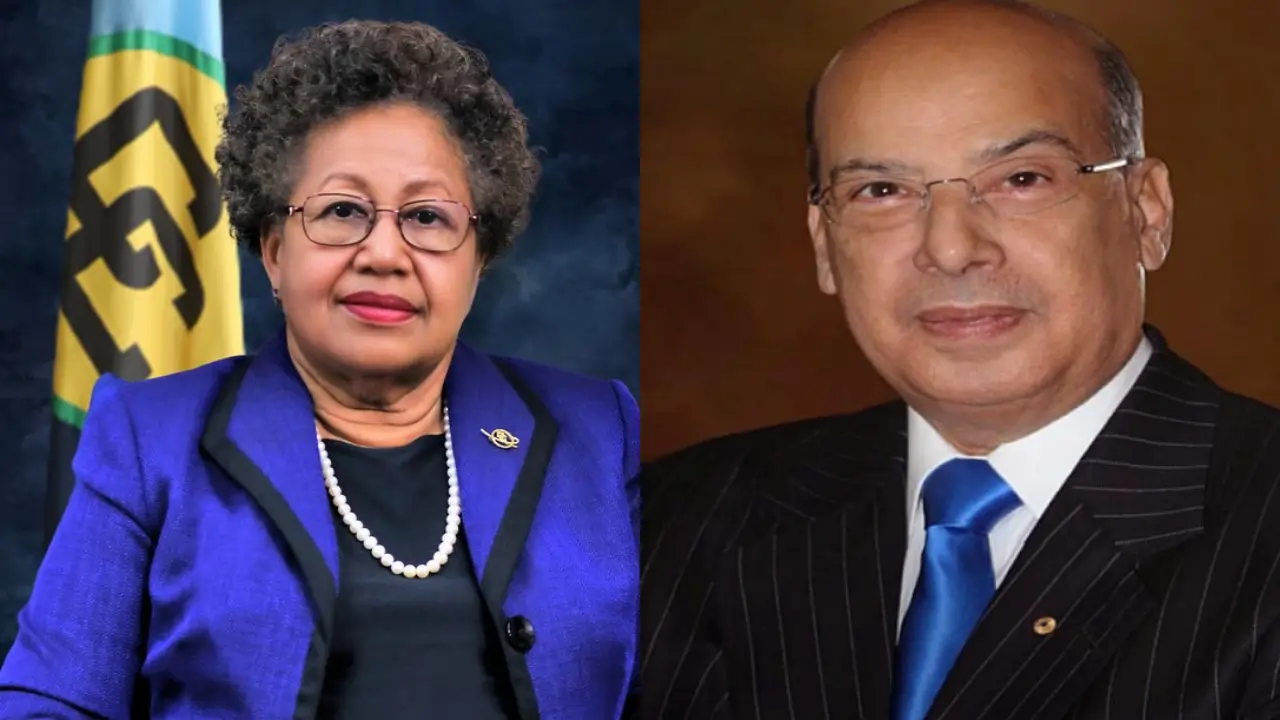
ST. JOHN’S, Antigua and Barbuda — Ronald Sanders Calls for Barnett Exit as a growing dispute over the leadership of CARICOM develops into one of the organization’s most serious governance challenges in recent years, after veteran diplomat Sir Ronald Sanders publicly backed the departure of Secretary-General Carla Barnett amid mounting controversy over her reappointment.
Sanders’ intervention adds new pressure to an already volatile standoff led by Kamla Persad-Bissessar, who has sharply criticized the process that returned Barnett to office and signaled that her government intends to keep challenging the decision.
What began as criticism over an internal appointment has now widened into a broader test of transparency, political trust and the ability of CARICOM’s leadership to manage conflict among its member states.
Legitimacy Concerns Grow as Ronald Sanders Calls for Barnett Exit
Sanders is widely regarded as one of the region’s most experienced diplomatic voices, making his remarks especially significant within Caribbean political circles.
By indicating that he would have resigned if placed in Barnett’s position, Sanders framed the issue as one of legitimacy rather than personality. His comments suggest that when confidence in the secretary-general’s office is openly contested by a major member government, the office itself can become weakened.
That distinction matters. The secretary-general is expected to facilitate dialogue, support implementation of regional decisions and help preserve institutional continuity. If the role becomes the center of political division, CARICOM’s ability to function effectively may be impaired.
The intervention also signals that concerns over the dispute are no longer confined to domestic politics in Trinidad and Tobago or private diplomatic discussions. They are now being voiced publicly by senior regional figures.
Kamla Persad-Bissessar Intensifies Challenge
Persad-Bissessar has accused CARICOM leaders of using an improper and opaque process to secure Barnett’s reappointment. Her criticism has gone beyond procedure, extending to the broader governance culture inside the regional body.
Her position carries particular weight because Trinidad and Tobago remains one of CARICOM’s largest economies and an influential voice on trade, energy, security and regional diplomacy.
A sustained breakdown between Port of Spain and the CARICOM leadership could complicate consensus on major policy matters, especially at a time when Caribbean states face rising economic pressures, migration concerns, climate threats, and shifting global alliances.
The controversy has widened beyond a routine appointment dispute and follows earlier concerns raised over the reappointment process in the CARICOM Barnett reappointment crisis.
The longer the dispute continues, the more difficult it may become to separate questions about Barnett’s appointment from wider concerns about how the bloc conducts its business.
Scrutiny Grows on Chairman Terrance Drew
Attention is also turning to Terrance Drew, who currently chairs the organization.
Critics argue that the moment requires active mediation, transparent communication, and a credible pathway toward restoring trust among member governments. Instead, opponents say the response so far has failed to calm tensions or answer the central concerns being raised.
For any regional institution, leadership during internal crisis is often judged not only by decisions made, but by whether confidence can be rebuilt once divisions emerge.
If member states begin to view disputes as unresolved or poorly handled, future negotiations could become harder and cooperation more fragile.
Why the CARICOM Crisis Matters
CARICOM was established to strengthen regional integration, expand economic cooperation, and amplify the Caribbean’s collective voice on the global stage.
Visible fractures at the top of the organization risk undermining that mission. Confidence in common institutions is essential for advancing shared initiatives, from trade arrangements and free movement discussions to security coordination and international advocacy.
If leading member states disengage or openly challenge internal processes without resolution, the consequences could extend beyond the current dispute. Delayed decision-making, weaker coordination, and growing public skepticism about regional governance are among the potential risks.
For now, the controversy surrounding Barnett’s future has become more than a leadership dispute. It is a test of whether CARICOM can confront internal dissent, restore confidence, and preserve the unity it was created to protect.