








CARACAS, Venezuela — The Venezuela earthquake that struck in twin succession on Wednesday evening has killed at least 589 people and injured 2,980 others, acting President Delcy Rodríguez confirmed Friday in a state television address, as rescue crews from more than a dozen countries race against a closing biological window to pull survivors from the ruins of collapsed buildings across the capital and the coastal state of La Guaira.
The disaster began at approximately 6:04 pm local time on Wednesday, June 24, when a magnitude 7.2 earthquake struck west of Caracas, followed 39 seconds later by an even more powerful magnitude 7.5 tremor in the same region. The 7.5 is the strongest earthquake to hit Venezuela since 1900, according to the United States Geological Survey. The death toll climbed rapidly through the two days that followed, rising from 32 confirmed dead in the first overnight hours, to 164 by Thursday morning, to 235 by Thursday night, before Rodríguez’s Friday figure of 589 confirmed fatalities.
A volunteer-run website tracking missing persons had logged more than 46,000 names as of Friday. Venezuelan officials have not confirmed that figure, and rescue operations in the hardest-hit zones remain incomplete.
Caracas and La Guaira Bear the Worst of Venezuela Earthquake’s Destruction
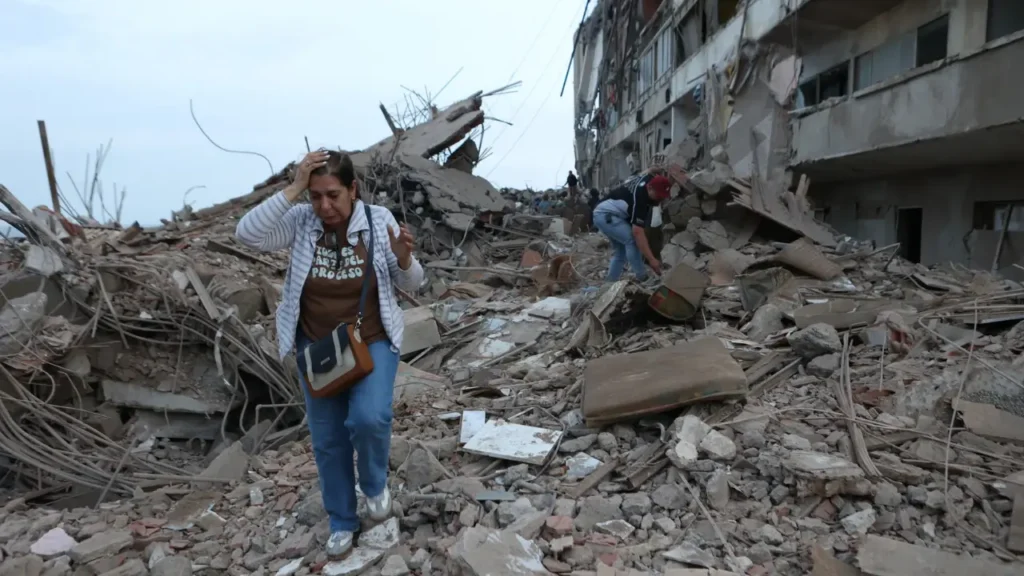
The Altamira and El Paraiso neighbourhoods of Caracas sustained the most severe urban destruction, while damage across the coastal state of La Guaira was extensive across multiple communities. Rodríguez formally declared La Guaira a disaster zone and said the region had been militarised, with troops deployed alongside heavy machinery to support search-and-rescue operations and the distribution of food and water to displaced residents.
An AFP journalist witnessed a 22-story building completely destroyed in the Altamira neighbourhood, where relatives called out the names of the missing as volunteers climbed across the rubble. A waterfront hotel in the coastal city of Macuto was among the dozens of buildings reduced to rubble. Thousands of Caracas residents, unwilling to return to structurally unverified buildings, spent Wednesday night and Thursday sleeping outdoors or in their vehicles.
Volunteer websites came online within hours of the disaster. The most widely used, “Desaparecidos Terremoto Venezuela,” was created to help people search for missing loved ones. Médecins Sans Frontières reported that many displaced residents had gathered in public spaces carrying only what they could grab, while local councils worked to establish emergency shelters in schools and baseball stadiums.
National Assembly President Jorge Rodríguez said more than 200 people were confirmed trapped in the debris of collapsed buildings as of Thursday, with teams in what he described as a tireless race against time. Venezuela also established a $200 million reconstruction fund for hospitals, homes, and other collapsed infrastructure.
Images of Simón Bolívar International Airport showed cracked walls, collapsed ceiling panels, and debris across sections of the facility. The airport remained closed Friday, complicating the logistics of incoming international aid. Metro and rail services across the capital were also suspended, and school closures were extended through the end of the week.
Why the Damage Was So Catastrophic: Geology, Housing, and a Public Holiday
A geophysicist at the University of California, San Diego, explained that Venezuela sits along a massive strike-slip fault zone at the boundary of the Caribbean and South American tectonic plates. Caracas itself lies in a deep sedimentary basin, a geological feature that amplifies seismic waves considerably above open-ground levels.
The USGS attributed the scale of structural failure in part to Venezuela’s widespread use of unreinforced brick masonry and adobe in residential construction, materials that perform poorly under high-magnitude shaking. Approximately 80 percent of Venezuela’s population lives in earthquake-prone areas, and significant portions of urban housing, particularly in the hard-hit Altamira district, were built on sediment deposits that further amplified the seismic impact. Informal housing across several areas of the country compounded the vulnerability.
The strikes came on a national public holiday marking Venezuela’s 1821 Battle of Carabobo, meaning the majority of the population was at home in residential buildings rather than dispersed across workplaces, concentrating exposure at the moment of impact.
A seismology expert noted that the magnitude difference between the two events understates their combined destructive effect. The 7.5 released roughly twice the energy of the 7.2, meaning shaking intensified precisely as the first event had already placed structures under stress, extending ground movement across a prolonged duration and a far wider area.
The Venezuelan Seismological Agency recorded more than a dozen smaller earthquakes in the hours following the main strikes. USGS forecasting placed a 94 percent probability on at least one magnitude 5 aftershock within the following week, and a 40 percent probability of a magnitude 6 or larger event in the same region during that window.
US Military Deploys Ships as Global Rescue Response Escalates
US Southern Command confirmed Friday it is surging military forces in the region to support earthquake relief. Two US Navy ships, the amphibious vessel USS Fort Lauderdale and the littoral combat ship USS Billings, were repositioned toward Venezuela, alongside transport aircraft and helicopters. US Marine Major General Kevin Jarrard was dispatched to Caracas to oversee the Pentagon’s relief operations on the ground.
The US Treasury announced it would permit all transactions with Venezuela related to earthquake relief efforts, a temporary easing of existing sanctions authorised from June 26 through October 23. The State Department separately announced $150 million in US aid, with search and rescue teams from Fairfax County, Virginia, and Los Angeles County already deployed alongside a Disaster Assistance Response Team providing coordination expertise.
Spain dispatched 58 search-and-rescue personnel, eight canine units, and 40 firefighters via military aircraft, along with funding and a field hospital. France and the Czech Republic deployed firefighters, engineers, and rescue dogs. China said it was willing to provide assistance and mobilised companies with operations in Venezuela to support clean-up efforts. India’s foreign affairs ministry announced the shipment of more than 35 tonnes of relief supplies, medicine, and medical equipment. Japan’s Peace Winds disaster relief organisation also dispatched a team.
The UN’s top humanitarian official, Tom Fletcher, said his office was coordinating international deployment of urban search and rescue teams, noting that even before the earthquakes, nearly 8 million people in Venezuela were already in need of humanitarian support.
Rescue specialists described a round-the-clock operation against what experts call the “golden window,” the 48-to-72-hour period after a structural collapse during which survival rates for those trapped without water drop sharply. By Friday, that window had either closed or was closing for those buried since Wednesday evening, placing immediate urgency on the pace of debris clearance across La Guaira and Caracas.
Venezuela’s censorship infrastructure added a second layer of crisis to the disaster response. More than 200 websites remained blocked inside the country, including international news outlets and social media platforms, while VPN circumvention tools were also restricted. A nearly two-year ban on X was partially lifted following UN pressure, though internet users in parts of the country were still unable to load images or video. The state-run telecommunications provider made internet, telephone, and television services free for 48 hours to assist families attempting to reach one another.
Analysts watching Rodríguez’s handling of the disaster noted that its scale presents both a severe test and a political opportunity for a leader who came to power with US support after the capture of former President Nicolás Maduro, and who has worked to liberalise Venezuela’s economy while leaving its broader political structures largely intact. The confirmed death toll of 589 is, by every available measure, a floor.