










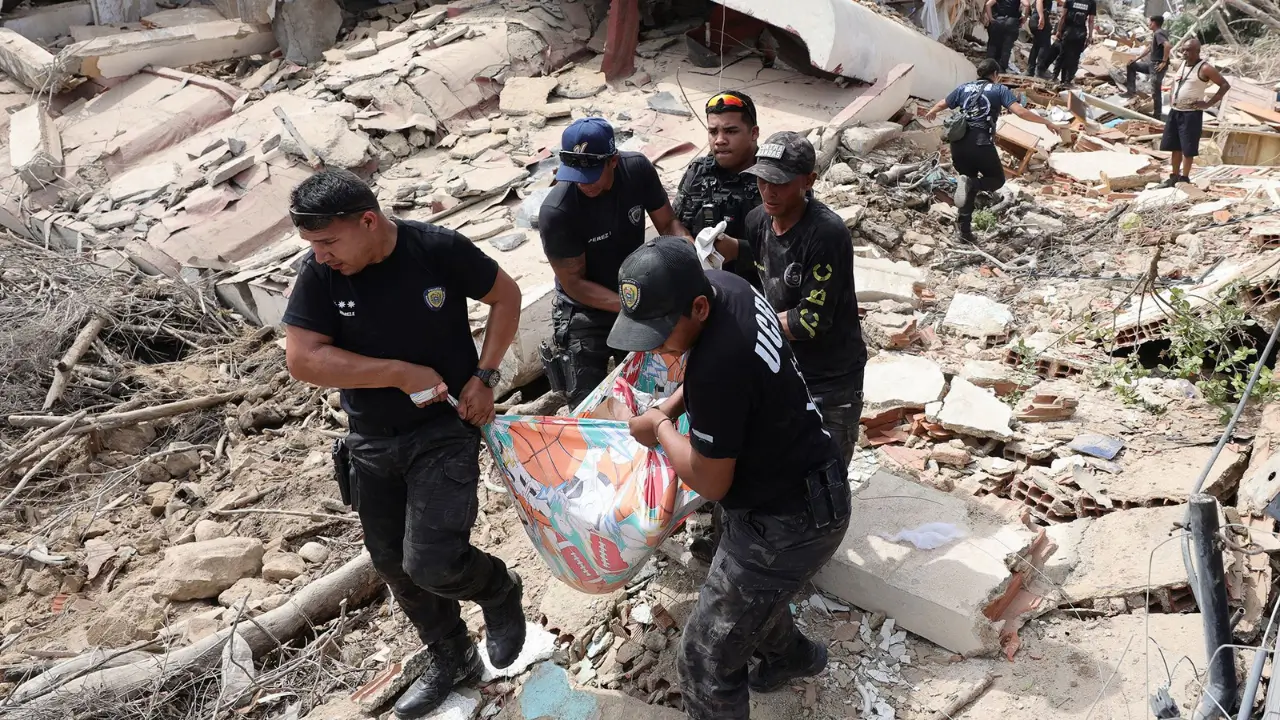
CARACAS, Venezuela — The Venezuela earthquake death toll surged to at least 920 on Friday afternoon, National Assembly President Jorge Rodríguez confirmed, as the biological window for pulling survivors alive from the rubble of collapsed buildings across Caracas and the coastal state of La Guaira narrowed to its final hours. At least 3,360 people have been injured, and 172 remain confirmed trapped beneath debris, with both figures expected to climb further as rescue crews push deeper into the hardest-hit zones.
The death toll includes nationals from Brazil, China, Spain, and Portugal alongside Venezuelans. Rodríguez confirmed that 383 buildings have been affected across the disaster zone and reiterated that La Guaira remains fully militarised, urging the public not to travel to the region. “We appreciate the overwhelming desire to help, but the roads we are using to transport the injured are becoming congested. The best way to help is to keep the roads clear so that medical teams can transport patients and rescue crews can carry out their work more effectively,” he said.
A volunteer-run missing persons registry listed more than 50,000 people as unaccounted for by Friday, with approximately 8,000 of those subsequently located. The figures have not been independently confirmed by Venezuelan authorities.
Rescue Window Closes as Venezuela Earthquake Death Toll Reaches 920
Search and rescue operations are described as extremely difficult, with Fairfax County battalion chief Robert Schoenberger telling reporters that extracting a single person from the rubble safely can take between 12 and 48 hours, depending on the variation of structures and conditions encountered at each site.
Scores of off-road vehicles and buses have been dispatched between La Guaira and Caracas bearing heavy machinery and essentials for the rescue operation, according to the Venezuelan Ministry of Transport. Fifteen buses moved international rescue personnel from El Libertador Air Base southwest of Caracas to hard-hit locations Friday. Humanitarian aid from the city of Valencia, to the capital’s west, was also expected to reach affected areas through the day.
On the ground, coordination remained uneven. Volunteer Sebastian Arias described moving between collapsed sites across Caracas and finding some locations overcrowded with helpers while others appeared to lack both equipment and personnel. Residents in coastal areas expressed frustration with the pace of the official emergency response, and doctors reported that chronic underfunding had left the healthcare system ill-equipped to absorb the surge of casualties.
A power outage on a key transmission line in Venezuela’s central region was also slowing efforts to restore full service at the port of Puerto Cabello, the El Palito refinery, and the Moron petrochemical complex.
Global Aid Escalates as Pope Leo Sends Emergency Funds to Venezuela
Pope Leo XIV sent 100,000 euros, approximately $114,000, in humanitarian aid to Venezuela on Friday, channelled through the papal almoner’s office following consultations with the apostolic nuncio to Venezuela, Archbishop Alberto Ortega Martín, and the Archbishop of Caracas, Archbishop Raúl Biord Castillo. The Vatican described the donation as an initial step, with further assistance to follow as needs on the ground are assessed.
UN humanitarian agencies issued a joint call for solidarity, urging rapid and unimpeded humanitarian access to affected populations. “The people of Venezuela need solidarity now,” the heads of the Inter-Agency Standing Committee said in a statement, warning that the international community must not allow the emergency to deepen into a larger human tragedy.
Urban search and rescue teams from Colombia and Ecuador were confirmed on the tarmac at Simón Bolívar International Airport in Maiquetía on Friday, joining US, Spanish, French, and other international teams already deployed across the disaster zone. Spain’s Emergency Military Unit landed with 58 personnel, eight canine units, and 40 firefighters. Brazil dispatched rescue teams from São Paulo’s Air Force Base, with personnel boarding aircraft bound for Venezuela on Friday morning.
The last earthquake of comparable scale to strike the Caracas region occurred in 1967, when a magnitude 6.7 tremor killed more than 200 people. Wednesday’s twin strikes, at magnitudes 7.2 and 7.5, were felt across at least five northern states along the Caribbean coast and represent the most destructive seismic event in Venezuela in more than a century. With the confirmed Venezuela earthquake death toll at 920 and the United States Geological Survey modelling placing the most probable final count in the thousands, the full human cost of this disaster remains unresolved.