














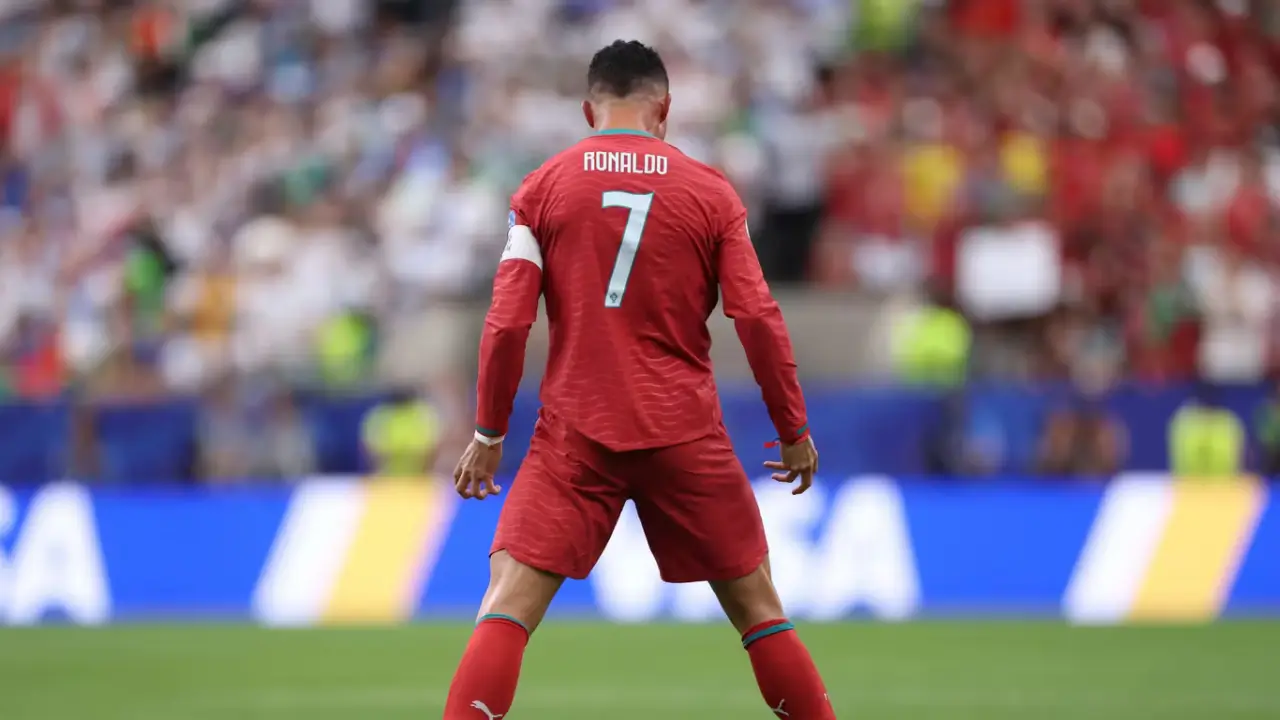
HOUSTON — The Ronaldo World Cup Record was rewritten in just six minutes Tuesday night, as the Portuguese captain buried a right-footed close-range finish from João Cancelo’s cross to become the first player in the history of the competition to score at six different FIFA World Cups. By the time the final whistle sounded at Houston Stadium, Portugal had dismantled Uzbekistan 5-0 in a performance that erased the doubts surrounding their campaign and announced their intentions for the knockout rounds.
The night’s second major fixture produced no goals but plenty of drama in its own right. At Boston Stadium, Ghana frustrated England to a scoreless draw that left both sides level on four points heading into the decisive final group match day in Group L.
Ronaldo World Cup Record Stands Alone
Portugal entered the match under significant pressure. Their 1-1 draw against DR Congo in the Group K opener had drawn criticism of both the team’s structure and Ronaldo’s continued place in the starting eleven at 41. Roberto Martínez silenced those questions emphatically.
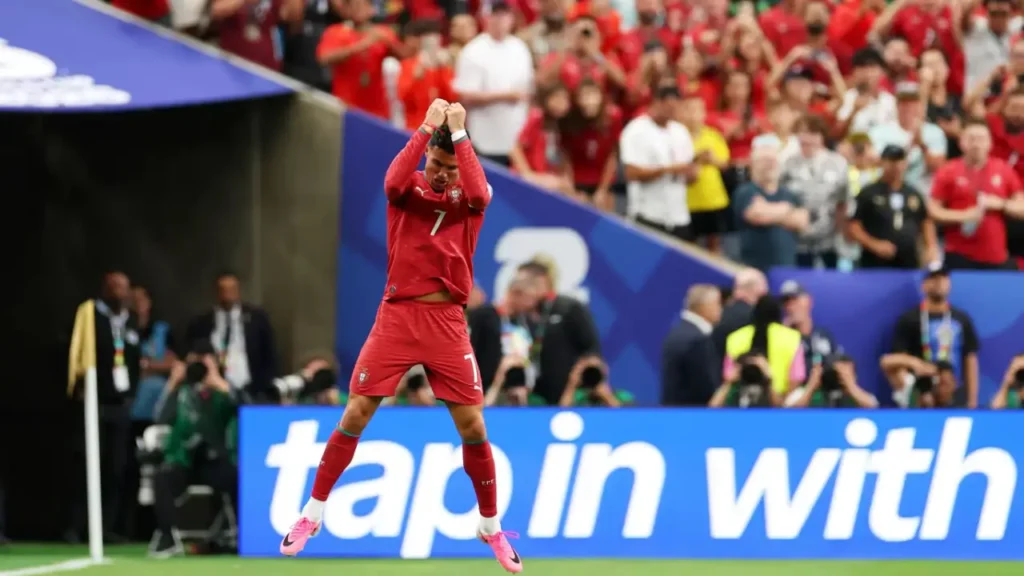
The full goalscorer sequence, Ronaldo (6, 39), Mendes (17), an Uzbekistan own goal (60), and Leão (87) is confirmed in the official FIFA match report. Portugal registered 17 attempts across the full 90 minutes and controlled the match from the opening exchanges.
The achievement arrived just days after Lionel Messi broke the all-time World Cup scoring record, making the 2026 tournament a landmark edition for individual goalscoring history and cementing this World Cup as one of the most historically significant for the sport’s two greatest modern players.
Mendes was central to Portugal’s attacking structure throughout, his overlapping runs from left back repeatedly stretching Uzbekistan’s defensive shape and creating the central space Ronaldo and Leão needed to operate. Mendes scored with a clever free-kick routine that doubled Portugal’s lead before Ronaldo coolly slotted in from Bruno Fernandes’ perfectly weighted throughball to make it three before the break.
Portugal’s fourth came on the hour when a low ball into the box took a series of deflections and ended up in the net after ricocheting off Abdukodir Khusanov and goalkeeper Abduvohid Nematov, before Leão completed the rout when he lashed into the roof of the net as a clearance rolled into his path.
Martínez described the performance as one built on tactical maturity, emphasizing that the team had approached the fixture with patience rather than emotion, a pointed reference to the reactive and disjointed display against DR Congo. Ronaldo himself said the most important factor was the team’s collective confidence and work rate, adding that records are always welcome but his goal is always to help the national team achieve its objectives.
For Uzbekistan, the result exposed the distance between a tournament debutant and one of Europe’s elite sides. The Central Asian debutants had entered without a point after losing 3-1 to Colombia in their opening match, and produced only isolated moments of attacking intent against Portugal before being overrun. Their survival in the group now depends entirely on other results.
Ghana’s Defensive Discipline Frustrates England
Boston hosted an entirely different contest, defined not by goals or individual brilliance but by one team’s willingness to sacrifice possession entirely in pursuit of a point.
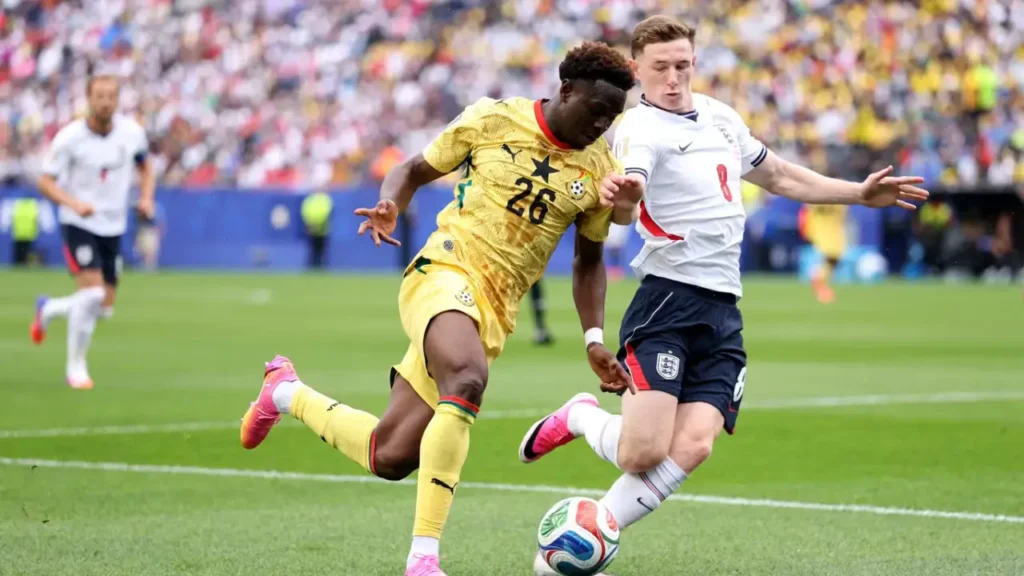
England had 78.8 percent possession against Ghana, their highest ever figure in a FIFA World Cup match on record since 1966, and also the most by any side that failed to score in the competition over the same period, according to FIFA match data. The statistic captured the night’s central story: Ghana did not come to play, they came to hold.
Ghana had just two shots across the full 90 minutes, the fewest England have faced in the World Cup on record since 1966. Coach Carlos Queiroz deployed a deeply compact defensive structure that denied Harry Kane meaningful touches in dangerous areas and forced England into prolonged, low-penetration possession spells around the edge of the defensive block.
England’s 104 successful passes ending in the final third were the most by a side that had failed to register a shot on target in the first half of a World Cup game on record since 1966. The volume of ball movement was considerable. The end product was not.
Thomas Tuchel introduced Bukayo Saka and Marcus Rashford after halftime in an effort to unlock Ghana’s shape, and England began to generate more threatening positions. Saka’s curling shot was brilliantly stopped by goalkeeper Benjamin Asare, before Nico O’Reilly headed Reece James’ cross against the woodwork, with the rebound falling to Kane, who fired over from six yards out.
Ghana also had cause to feel aggrieved. Substitute Prince Adu was played in behind and appeared to be caught by a wayward Ezri Konsa slide, a decision waved away by both the on-field officials and VAR. Queiroz did not hold back, questioning publicly whether the video review system had been functioning at the time of the incident.
England’s struggle to break down a compact defensive opponent extended a pattern that has now afflicted them across four successive major tournaments, following similar second-game difficulties against Scotland at Euro 2021, the United States at the 2022 World Cup, and Denmark at Euro 2024.
Qualification Picture Tightens Across Both Groups
Portugal now hold four points from two Group K matches and enter their final fixture against Colombia in control of their own progression. The result confirmed what their roster always suggested was possible: when the structure is right, and the attacking width is utilized, Portugal are capable of overwhelming any opponent in this field.
Both England and Ghana will enter their final Group L match on June 27 with four points apiece, meaning the final round of fixtures carries genuine stakes for both sides. England face Panama, while Ghana’s path forward depends on their own final group result.
The expanded 48-team format, which allows third-place finishers to advance to the Round of 32, has raised the value of every remaining point and elevated goal difference as a potential tiebreaker across multiple groups. Tuesday’s results reinforced two of the tournament’s emerging tactical themes: Portugal demonstrated how attacking width and aggressive fullbacks can dismantle organized defenses, while Ghana proved that a disciplined low-block structure can neutralize even the most possession-dominant opponents.
Ronaldo’s record may stand for a generation. No active player is currently positioned to match six World Cup scoring appearances, and the gap between his career arc and any realistic challenger is considerable. At 41, he added yet another chapter to a career that continues to redefine what is possible at international level, and Portugal will need both his goals and their newly rediscovered collective discipline to go deep in this tournament.