







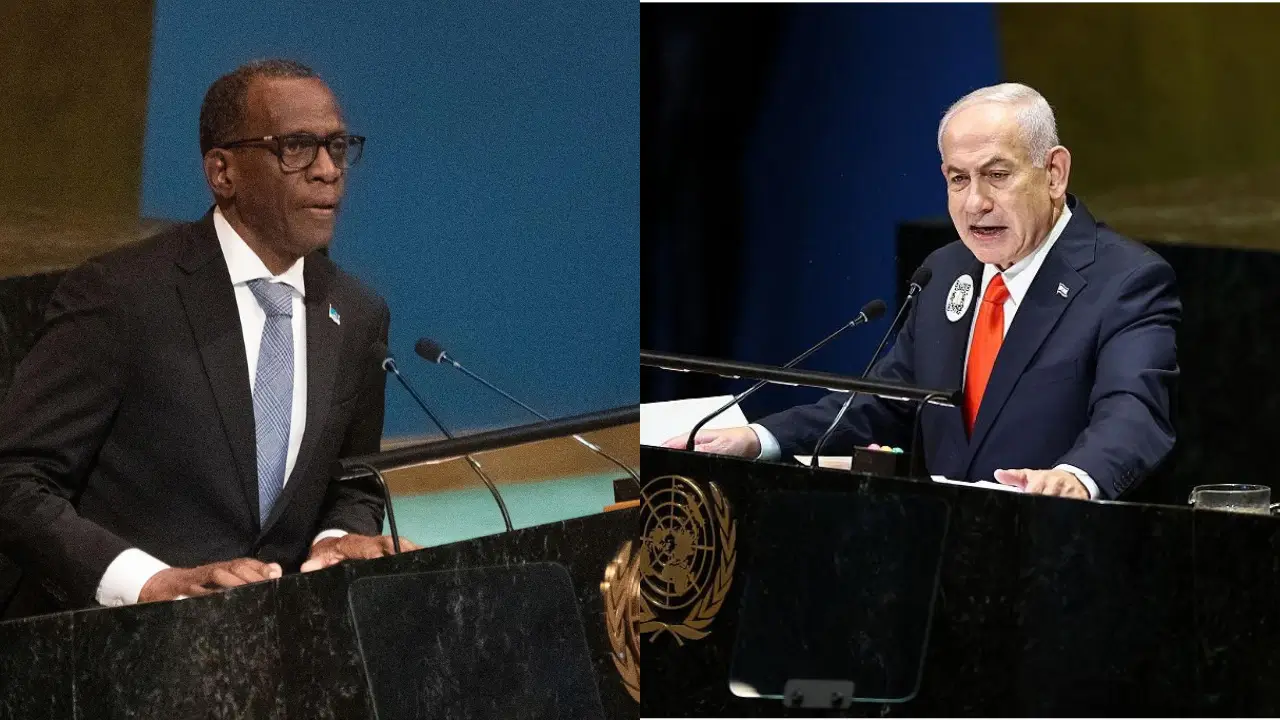
NEW YORK, US — The St Lucia Netanyahu walkout placed Prime Minister Philip J. Pierre’s government within one of the UN General Assembly’s most visible diplomatic protests Thursday, as the country’s delegation was reported among those leaving during an address by Israeli Prime Minister Benjamin Netanyahu.
Dozens of delegates streamed from the General Assembly hall as Benjamin Netanyahu prepared to speak, while other delegates remained and applauded. The Palestinian delegation had earlier urged diplomatic missions to participate in the protest.
Philip J. Pierre is in New York for the 81st Session of the UN General Assembly and is scheduled to deliver St Lucia’s national statement Friday, although available reporting does not establish that the prime minister personally joined those leaving the chamber.
Caribbean Protest Includes St Lucia Netanyahu Walkout
St Lucia was listed among 17 Latin American and Caribbean countries whose representatives reportedly left the chamber.
The Caribbean countries listed included Antigua and Barbuda, The Bahamas, Barbados, Belize, Dominica, Guyana, St Lucia and Suriname.
Brazil, Bolivia, Chile, Colombia, Cuba, Nicaragua, Panama, Peru and Venezuela were also among the Latin American countries identified in the protest.
The demonstration extended far beyond the Caribbean and Latin America.
Dozens of representatives from countries across Africa, Asia, Europe, the Middle East and the Pacific left as Netanyahu approached the podium, turning the opening moments of his address into a striking display of the international divisions surrounding Israel.
Netanyahu immediately confronted those who departed.
“If there are any other moral cowards who haven’t left this hall, please do so now,” he said.
He later argued that Israel was defending some of the same countries whose representatives had just left the chamber.
The Palestinian delegation had circulated a memo encouraging other diplomatic missions to participate in the protest, according to international reporting.
Pierre Government Has Backed Palestinian Statehood
St Lucia’s reported participation did not occur in a diplomatic vacuum.
The country has a documented record of supporting Palestinian statehood at the United Nations.
In May 2024, St Lucia was among the sponsors of a UN General Assembly draft resolution concerning Palestine’s application for full UN membership. The measure, later adopted 143-9 with 25 abstentions, determined that Palestine qualified for membership and recommended that the Security Council reconsider the matter favorably.
That history places Thursday’s action within a broader St Lucian foreign-policy position rather than presenting it simply as a reaction to Netanyahu’s appearance.
St Lucia’s position extended beyond the membership question. Later in 2024, the country was also listed among sponsors of a UN draft resolution addressing the Palestinian people’s right to self-determination.
At the same time, the Oct. 7, 2023, Hamas-led attack on Israel remains central to Israel’s justification for its military campaign. About 1,200 people were killed in Israel and 251 were taken hostage in the attack.
Israel maintains that its military operations are directed at Hamas and necessary for its national security.
The war and its humanitarian consequences have since produced increasingly sharp disagreements among governments over Israel’s conduct, Palestinian statehood and the appropriate international response.
Netanyahu Answers the Delegates Who Left
Benjamin Netanyahu used Thursday’s address to defend Israel against mounting international criticism.
The Israeli leader had signaled before appearing at the UN that he intended to challenge accusations against his country and defend Israel’s military actions.
His confrontation with the departing diplomats began almost immediately.
As delegates left and supporters applauded, the president of the General Assembly repeatedly called for order.
Netanyahu then accused governments criticizing Israel of hypocrisy and argued that Israeli military action had protected countries beyond Israel’s borders.
The walkout therefore became more than a symbolic protest outside the proceedings. It unfolded directly in front of the Israeli prime minister and became part of his response from the UN podium.
For St Lucia, that meant its delegation was reported among governments participating in a highly visible diplomatic protest during Netanyahu’s appearance.
Pierre Carries Dual Role at UN Assembly
The timing gives St Lucia additional prominence because Pierre is not attending this year’s General Assembly solely as the country’s prime minister.
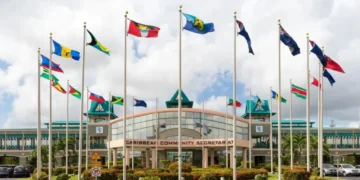
He is also chairman of the Caribbean Community.
Pierre assumed the rotating CARICOM chairmanship July 1 and is scheduled to serve through Dec. 31.
When taking over the position, Pierre said Caribbean countries could accomplish more collectively than individually and described the region as operating in a rapidly changing international environment.
His chairmanship does not mean St Lucia determines the individual foreign policies of other CARICOM governments.
Each member state retains authority over its diplomatic positions.
But Pierre’s regional role gives his presence in New York greater visibility at a time when several Caribbean governments are taking positions on conflicts involving some of the world’s most powerful countries.
Thursday’s walkout illustrated that reality.
Several CARICOM countries appeared among those reported to have participated, although the region was not unanimous in its response.
St Lucia Navigates Relations Beyond the Caribbean
The episode also highlights the increasingly complicated diplomatic environment confronting small Caribbean states.
St Lucia maintains significant ties with the United States while simultaneously pursuing its own positions at the United Nations and through regional institutions.
Washington is important to the wider Caribbean across tourism, trade, migration, security and development.
Israel, meanwhile, remains one of the United States’ closest international allies.
Those relationships do not require St Lucia to align with Washington on every international question, and disagreement at the UN does not by itself indicate deterioration in bilateral relations.
There was no verified indication Thursday that the Trump administration had linked the walkout to its relationship with the Pierre government.
The significance lies instead in St Lucia being reported among countries whose representatives left during an address by the leader of one of Washington’s closest allies, amid deep international disagreement over Israel and the Palestinians.
Caribbean Governments Take Visible Stand
The participation of multiple Caribbean countries also demonstrates how the Israeli-Palestinian conflict has increasingly reached the diplomatic agendas of small states far removed geographically from the Middle East.
Antigua and Barbuda, The Bahamas, Barbados, Belize, Dominica, Guyana, St Lucia and Suriname were among Caribbean states listed as participating in Thursday’s walkout.
Their involvement placed Caribbean representatives alongside governments from several continents in the protest.
But participation should not be interpreted as evidence that every country involved holds an identical position on Israel, Hamas, Gaza or the wider Middle East.
Governments have reached their positions through different diplomatic histories and policy considerations.
The walkout instead represented a shared act at a specific moment: leaving the General Assembly chamber as Netanyahu took the podium.
For St Lucia, it was a particularly visible act because Pierre is simultaneously representing the country at the UN and serving as CARICOM chairman.
Pierre Takes UN Podium Friday
Attention now turns to Pierre himself.
The St Lucia government confirmed that the prime minister will deliver the country’s national statement during the General Debate on Friday, Sept. 25.
His appearance will come one day after St Lucia was listed among countries participating in the Netanyahu walkout.
The government said Pierre is also expected to hold bilateral meetings in New York on matters affecting St Lucia.
His UN address will provide an opportunity to outline St Lucia’s positions on the international challenges dominating this year’s General Assembly, including international peace and security, climate change, development and financing.
Whether Pierre directly addresses Israel, Gaza or Palestinian statehood remains to be seen.
What is already clear is that St Lucia has entered one of the General Assembly’s most contentious diplomatic moments.
The country has previously supported Palestinian statehood through the UN, its delegation has now been reported among those leaving during Netanyahu’s address, and its prime minister will take the same international stage Friday while serving as chairman of CARICOM.
Pierre’s address will provide the clearest indication of how directly his government intends to connect St Lucia’s established position on Palestine with the diplomatic confrontation that unfolded inside the General Assembly on Thursday.