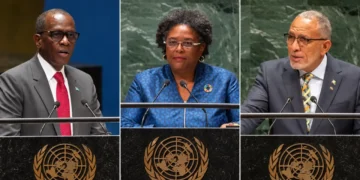
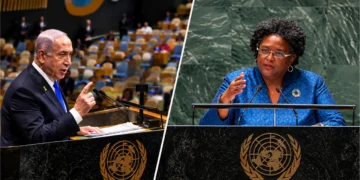








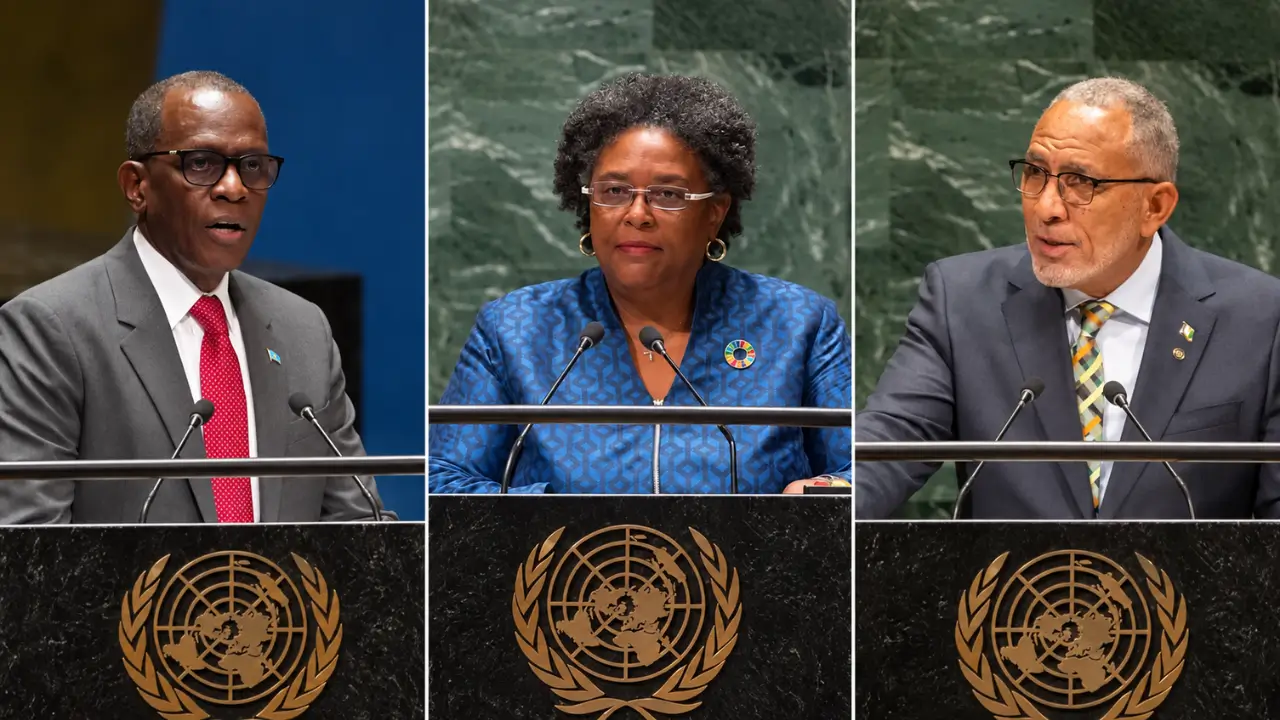
CASTRIES, St Lucia — UN walkout denials from St Lucia and Barbados, together with St Vincent and the Grenadines’ explanation that its representatives were elsewhere, have challenged reports of Caribbean participation in the protest during Israeli Prime Minister Benjamin Netanyahu’s address to the United Nations General Assembly.
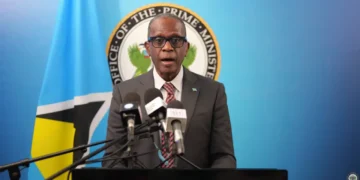
St Lucia Prime Minister Philip J. Pierre rejected reports of his country’s involvement during Monday’s pre-Cabinet press briefing, citing one representative who remained in the country’s seat. Barbados separately said Prime Minister Mia Mottley and its delegation remained in place.
St Vincent and the Grenadines offered a different clarification: Prime Minister Godwin Friday and the delegation were not in the General Assembly hall during Netanyahu’s speech, with officials attending meetings elsewhere or working at the country’s permanent mission.
The statements highlight distinctions between remaining in the chamber, being absent and deliberately leaving in protest. They also demonstrate why the presence or absence of representatives cannot, by itself, establish an entire delegation’s participation.
The broader walkout was independently documented. The disputed issue is which countries and individual representatives took part.
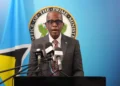
Pierre cites one seated delegate amid UN walkout denials
“Saint Lucia did not walk out,” Pierre said at the Sept. 28 briefing, referring to an individual who remained in the country’s seat during Netanyahu’s address.
His explanation challenges any suggestion that St Lucia was entirely unrepresented in the chamber. If accurate, it establishes that at least one representative stayed.
It does not, by itself, account for every delegation member’s movements or establish whether Philip J. Pierre was inside the hall when Netanyahu began speaking.
A delegation can retain representation while other members are elsewhere. Conversely, an official’s absence does not automatically establish participation in a walkout.
The distinction matters because earlier reporting associated St Lucia with the protest, placing the delegation’s actions under attention alongside those of other Caribbean countries.
No independently verified evidence reviewed for this article establishes that Pierre personally walked out. His categorical denial remains the government’s stated position.
The whereabouts of other delegation members remain unresolved in the account available from Monday’s briefing. That gap does not establish that they participated in the protest or that Pierre’s denial was false.
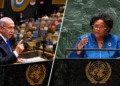
Barbados says Mottley and the delegation remained
Barbados’ Prime Minister’s Office issued its clarification Sept. 27, expressly accounting for both Mia Mottley and the delegation.
The office said they remained in place while finalizing the speech Mottley delivered later Thursday afternoon. It also pointed to her address as setting out Barbados’ position on the current war and the longstanding Arab-Israeli conflict.
The Barbados denial differs in specificity from Pierre’s explanation. It explicitly includes the prime minister and delegation, whereas Pierre cited one individual in St Lucia’s seat.
Both remain official accounts rather than independent verification of every representative’s movements.
Barbados’ clarification disputes its inclusion among participants without challenging the evidence that diplomats from other countries left the chamber.
St Vincent says its representatives were elsewhere
St Vincent and the Grenadines’ statement addressed claims that Friday and his delegation remained seated while other countries walked out.
The Prime Minister’s Office said that account was incorrect because the prime minister and delegation were not in the hall during Netanyahu’s address.
According to the statement, delegation members were at the Permanent Mission of Saint Vincent and the Grenadines to the United Nations. Friday and Foreign Minister Dwight Fitzgerald Bramble were engaged in meetings elsewhere. NBC Radio reported the clarification Sept. 25.
That explanation provides the government’s account of its representatives’ absence. It does not confirm that they entered the chamber and then left as part of the protest.
St Vincent’s clarification therefore addresses a different claim from those rejected by St Lucia and Barbados. It disputes suggestions that its representatives stayed, while the other two governments dispute reports that theirs walked out.
Treating all three statements as identical denials would obscure what each government said.
Empty seats do not establish a protest
Netanyahu addressed the General Assembly in New York on Sept. 24. Reuters documented dozens of delegates leaving as he took the podium. The Israeli leader described those departing as “moral cowards.”
The protest generated reports identifying countries whose representatives walked out or were absent. Those categories require separate treatment.
Footage showing an identifiable representative leaving can establish a departure. Determining whether that departure was part of a protest requires attention to its timing, circumstances and any accompanying explanation.
An empty seat alone cannot establish when someone left or why. St Vincent’s account illustrates that limitation: its government attributed its delegation’s absence to work and meetings elsewhere.
An occupied seat has limits as well. It establishes a representative’s presence at a particular moment without necessarily accounting for everyone associated with that country’s delegation.
The Caribbean statements consequently challenge some country-level accounts without undermining the independently documented broader walkout.
Pierre maintains support for Palestinian statehood
Pierre also emphasized Monday that his denial did not alter St Lucia’s position on conflicts in the Middle East.
In his Sept. 25 General Assembly address, he expressed concern about conflict and human suffering in Ukraine, Sudan, Gaza and the wider Middle East, calling for peace, stability and respect for international law.
He reaffirmed support for Palestinian self-determination, statehood and full UN membership alongside Israel, referring to UN resolutions, including Resolution 3236 of 1974.
A country’s position on Palestinian statehood and its representatives’ conduct during Netanyahu’s speech are separate matters.
Remaining for an address does not, by itself, establish agreement with the speaker. Supporting Palestinian statehood likewise does not establish participation in a particular protest.
St Lucia’s US dealings provide diplomatic background
Pierre’s clarification comes during a significant period in St Lucia’s dealings with Washington, including cooperation involving third-country nationals removed from the United States.
Speaking on Radio 100’s “What Makes You Mad” on Sept. 17, Pierre described the arrangement as one of his government’s most difficult decisions.
He said negotiations produced terms allowing St Lucia to accept up to 10 people every three months, compared with an initial proposal that did not specify a number.
“If you’re a Prime Minister of a country, you’ll tell the United States no?” Pierre said while discussing those negotiations.
The Ministry of External Affairs has said people accepted under the program face screening and eligibility requirements, with agreed safeguards and national security considerations governing implementation.
In January, the ministry also responded to an announced U.S. pause on immigrant visa issuance affecting St Lucia and other countries. Its statement distinguished that measure from nonimmigrant visa categories and reaffirmed the government’s commitment to bilateral relations with Washington.
These developments provide diplomatic background. They do not establish a motive for Pierre’s walkout denial.
No verified link to US pressure over the walkout
The Trump administration’s opposition to International Criminal Court action against Netanyahu forms another part of the international setting.
A February 2025 executive order authorized sanctions in response to ICC activities involving U.S. personnel and allies, including Israel. The Treasury Department’s ICC sanctions program records further designations during 2026.
Those measures concern the court and related activities. They do not establish consequences for a Caribbean country over a General Assembly walkout.
No verified evidence reviewed for this article links Pierre’s denial to a U.S. threat, a warning from Washington or concern about retaliation.
Delegation members’ movements remain the unresolved issue
The available statements offer three distinct accounts: St Lucia says it did not walk out and cites one seated representative; Barbados says Mottley and its delegation remained; St Vincent says its representatives were elsewhere.
For St Lucia, the remaining factual question concerns the whereabouts and movements of delegation members beyond the individual Pierre cited.
Identifiable footage or a fuller account of who was present before and during Netanyahu’s address could help resolve that question. On the available evidence, neither Pierre’s participation in the walkout nor every St Lucian delegation member’s continued presence in the chamber has been independently established.