











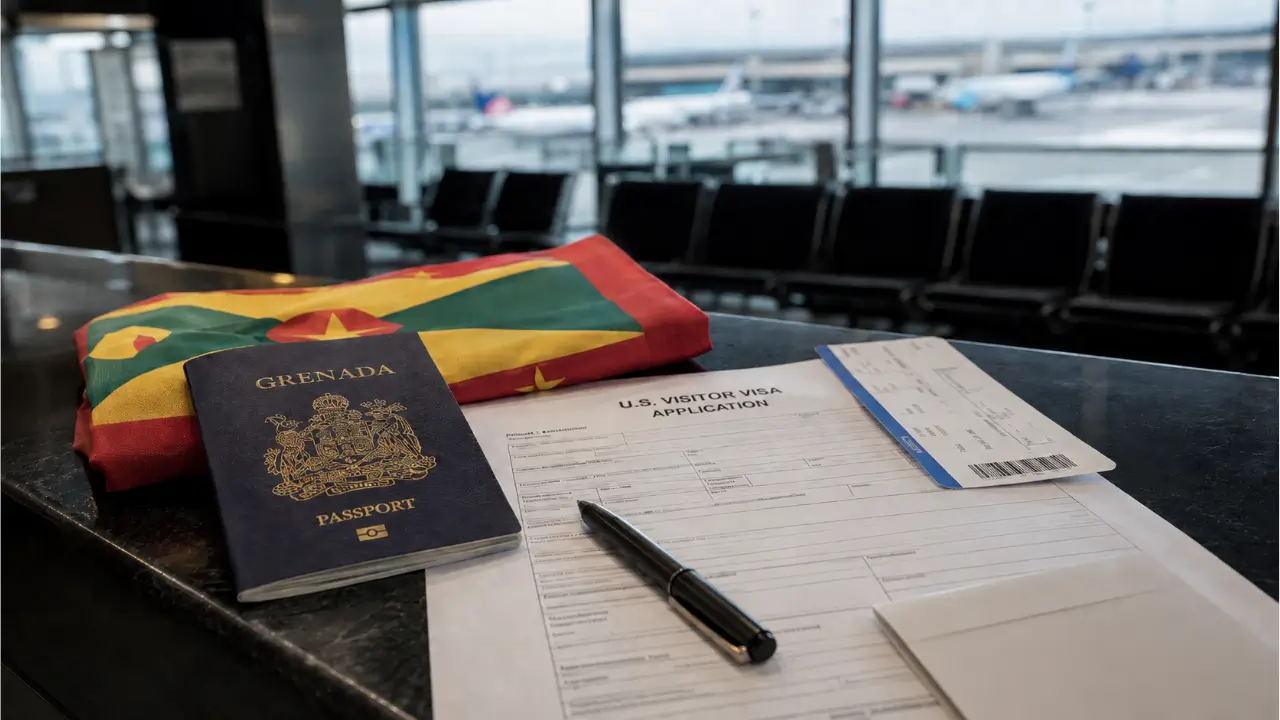
ST GEORGE’S, Grenada — The Grenada US visa bond requirement will become permanent Monday, exposing some Grenadian business and tourist visa applicants to refundable payments of up to US$20,000 before they can travel to the United States.
The new rule raises the maximum bond from US$15,000 and removes the previous US$5,000 payment option. Consular officers will instead be able to require bonds of US$10,000, US$15,000 or US$20,000 as a condition of issuing certain B1 or B2 visitor visas.
The permanent program takes effect Aug. 3 and covers nationals of 50 countries, including Grenada, Antigua and Barbuda, Dominica and Cuba. The US State Department says the requirement is intended to discourage visitors from remaining in the country beyond their authorized stay.
Permanent Rule Expands Grenada US Visa Bond
Grenada joined the visa bond pilot program April 2 after it was added to the US visa bond list, alongside Cambodia, Ethiopia, Georgia, Lesotho, Mauritius, Mongolia, Mozambique, Nicaragua, Papua New Guinea, Seychelles and Tunisia.
The designation applies to Grenadian citizens and nationals traveling on Grenadian passports, regardless of where they apply for a US visa. Grenada’s inclusion is confirmed under the US State Department’s visa bond requirements, which apply to nationals traveling on passports issued by designated countries.
The change adds another layer to Grenada visa requirements for some applicants, particularly those seeking temporary travel for business, tourism or family visits.
Although the bond is refundable when its conditions are followed, the upfront payment could create a significant financial obstacle for Grenadian travelers who cannot readily access thousands of US dollars.
At the highest level, US$20,000 is equivalent to approximately EC$54,000 under the Eastern Caribbean dollar’s fixed exchange rate. The amount would be held by the US government until the traveler complies with the bond conditions or qualifies for a refund under another provision.
Not every applicant will pay US$20,000
The permanent program does not mean every Grenadian applying for a visitor visa will automatically be required to pay the maximum amount.
A consular officer must first determine that the applicant is otherwise eligible for a B1, B2 or combined B1/B2 visa. The officer may then decide whether a bond is required and set the amount at US$10,000, US$15,000 or US$20,000.
The decision is made during the visa process and is based on the applicant’s circumstances.
The US tourist visa bond is separate from standard application fees and may be required before an otherwise eligible visa can be issued.
Payment of the bond does not guarantee that an applicant will receive a visa. It also does not guarantee admission into the United States, since US Customs and Border Protection officers retain the authority to make admission decisions at ports of entry.
The bond may be paid by the applicant or by a third party, including a relative, friend, employer or business associate. The person identified as the payer is also the person entitled to receive the refund when the bond is canceled without a breach.
All payments must be made in US dollars through the US Treasury Department’s Pay.gov system after a consular officer provides the applicant with official instructions.
The State Department has warned B1 B2 visa applicants against using unofficial websites or intermediaries to post visa bonds. Money paid outside the authorized government platform may not be protected or returned.
How Grenadian travelers recover the bond
The bond is generally canceled and refunded when the US Department of Homeland Security confirms that the visitor departed on or before the final date of the authorized stay.
The money may also be returned when the visa holder does not travel before the visa expires or when the person travels but is denied admission at a US port of entry.
A possible breach may be recorded when a traveler leaves after the authorized departure date, remains in the United States without permission or applies to change out of the temporary nonimmigrant status covered by the bond.
Travelers who post bonds are also required to use approved entry and departure points so US authorities can properly record their movements.
The State Department says bonded travelers may enter and leave through commercial airports, including locations where US Customs and Border Protection conducts preclearance.
They may not use charter aircraft, general aviation facilities, land crossings or seaports under the published requirements. Failure to use an approved location could result in the traveler’s departure not being properly recorded.
Grenada moved from pilot to permanent system
Grenada became subject to the program in April when the United States expanded the pilot to 50 countries.
Under the pilot, the available bond amounts were US$5,000, US$10,000 and US$15,000. The final rule eliminates the lowest option and introduces the higher US$20,000 ceiling.
The State Department said the pilot provided enough information to conclude that visa bonds could be used to encourage compliance among participating travelers.
The permanent measure represents a significant shift in US immigration policy for Grenadian travelers applying for short-term visitor visas.
US officials say the bond program is aimed at reducing visa overstays. Immigration advocates have argued that large upfront payments could also discourage legitimate visitors who qualify for visas but cannot afford to place thousands of dollars under government control for the duration of their travel.
Grenada’s Ministry of Foreign Affairs previously confirmed the country’s inclusion in the expanded program and advised that the measure related specifically to visitor visas for business and tourism. The government also emphasized that applicants would continue to be assessed individually.
Existing visitor visas are not automatically canceled by the permanent rule. The immediate impact falls on covered applicants seeking new B1, B2 or combined B1/B2 visas and directed by consular officers to post a bond.
For families, business owners and other Grenadian travelers with close connections to the United States, the increase means that receiving visa approval may no longer be the only major hurdle. Some applicants must also demonstrate that they can temporarily surrender as much as US$20,000 before making the journey.
Attention will now turn to how frequently US consular officers impose the maximum bond and whether Grenada renews diplomatic discussions with Washington as the permanent system takes effect.