


















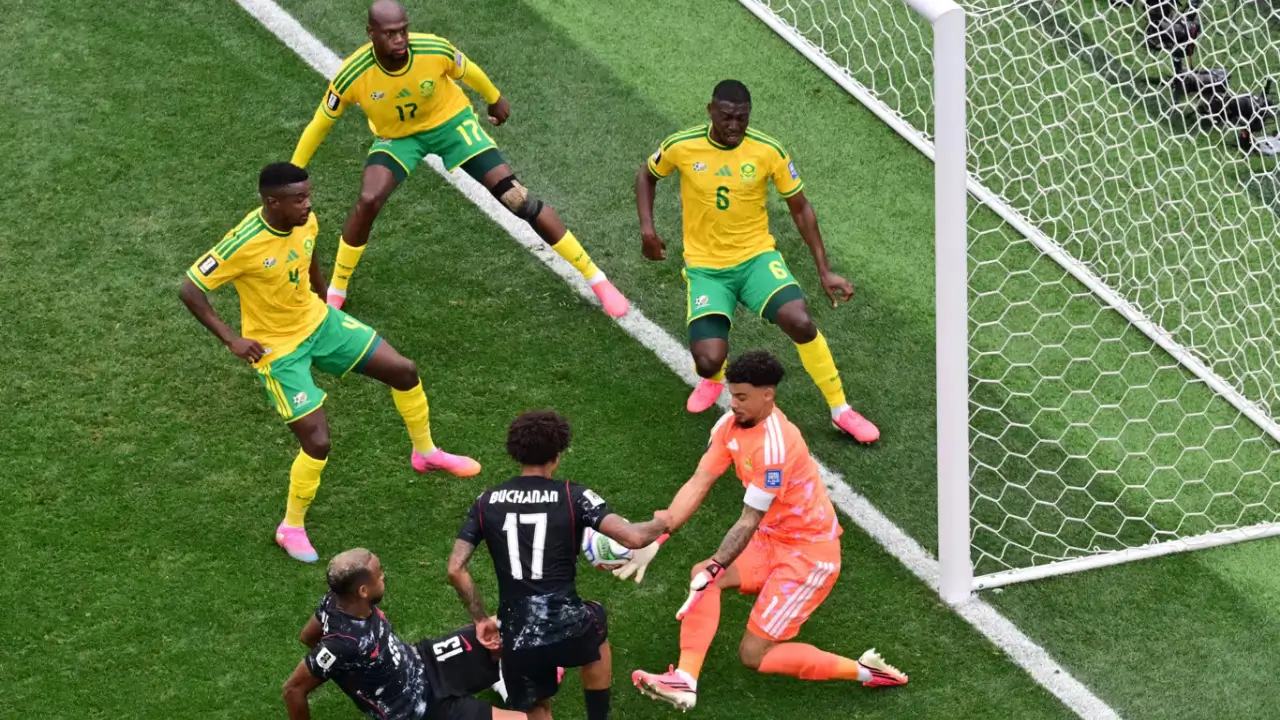
INGLEWOOD, Calif. — Canada reaches Round of 16 for the first time in its men’s FIFA World Cup history after Stephen Eustáquio scored a 92nd-minute winner to secure a 1-0 victory over South Africa on June 28, opening the 2026 World Cup knockout stage with a dramatic result that pushed the co-hosts into uncharted territory.

The completed June 28 match day in New York time featured only one fixture, but it carried major tournament significance. The Round of 32 began with the World Cup shifting from group-stage survival to single-elimination pressure, where Canada’s patience was rewarded and South Africa’s historic run ended minutes before extra time.
Canada reaches Round of 16 after late breakthrough
For more than 90 minutes at Los Angeles Stadium, Canada looked like the more likely team to score but struggled to break down a South African side built on defensive discipline.
Jesse Marsch’s team controlled possession for long stretches, moved the ball patiently and generated the better attacking pressure. Canada tried to stretch South Africa by using the width of the field, switching play and looking for openings around the edge of the penalty area.
South Africa refused to give Canada a clear path through the middle.
Bafana Bafana defended deep, kept two compact lines and repeatedly forced Canada into crosses, shots from distance or crowded attacking moments. The African side spent much of the match without the ball, but its structure frustrated the co-hosts and slowly pulled the contest toward extra time.
The decisive moment came in stoppage time.
After another spell of Canadian pressure around the South African penalty area, the ball fell to Eustáquio near the edge of the box. The midfielder struck a powerful finish beyond goalkeeper Ronwen Williams in the 92nd minute, giving Canada the breakthrough it had been chasing all afternoon.
FIFA’s match report confirmed Canada’s 1-0 victory, listing Eustáquio’s goal at 90+2 and noting that Jesse Marsch’s side advanced to face the Netherlands-Morocco winner at Houston Stadium.
The goal proved decisive, holding through the final whistle and sending Canada into the Round of 16 for the first time at a men’s World Cup.
It was one of the latest winning goals of the tournament and instantly became one of the most important moments in Canadian football history. For a co-host nation still building its place in the men’s game, the victory represented more than advancement. It was a statement that Canada could survive the pressure of knockout football.
Knockout stage opens with thin margins
The June 28 World Cup recap carried significance beyond the scoreline because it marked the tournament’s shift from group-stage survival to knockout elimination.
Only one match was played on the opening day of the Round of 32, but Canada and South Africa produced the clearest possible reminder that the tournament had entered a different stage. The group phase allowed teams to recover from setbacks, calculate standings and survive through goal difference or third-place qualification.
The shift came one day after the World Cup group stage ended with England, Colombia and DR Congo advancing, finalizing the Round of 32 field and setting up the single-elimination phase.
The knockout stage offers no such protection.
Canada’s win showed how thin the margins become when every match is winner-take-all. A side can dominate possession and still sit one mistake away from extra time. A disciplined underdog can defend well for nearly the entire contest and still see its campaign end with one late breakdown.
That pressure shaped the match from the opening stages.
Canada had to balance urgency with patience. South Africa had to remain organized while absorbing repeated pressure. The longer the game stayed level, the greater the emotional weight became for both teams.
Canada handled that pressure better in the decisive moment.
Rather than rushing low-percentage attacks, Marsch’s side continued to circulate possession and force South Africa to defend. That approach created the late opening Eustáquio finished, turning a tense tactical contest into a historic Canadian victory.
For readers following the tournament across the Caribbean and beyond, the match also signaled a broader shift. The World Cup is no longer about who looks promising. It is now about who can survive each moment.
Davies adds spark in tournament debut
Alphonso Davies’ return added another major storyline to Canada’s June 28 victory.
Canada’s captain had missed the entire group stage because of a hamstring injury and began the Round of 32 match on the bench. Marsch managed his minutes carefully, a sign that Canada was balancing the immediate need to win with the longer-term importance of protecting one of its most influential players.
Davies entered during the second half and immediately changed Canada’s attacking rhythm.
His pace stretched South Africa’s back line and forced defenders to cover wider spaces. His movement also helped create more room for Jonathan David and Tajon Buchanan, giving Canada greater energy and threat in the closing stages.
Davies did not score and was not credited with an assist, but his impact was clear.
Canada became more aggressive after his introduction, sustained pressure more effectively and pushed South Africa deeper inside its own half. The winner came after Canada had increased the tempo and forced Bafana Bafana into repeated defensive actions.
His return could matter even more in the next round.
Canada now moves forward with its captain back on the field, even if his fitness still requires careful handling. In knockout football, the ability to bring an elite runner off the bench can change a match, especially against tiring defenders.
Davies gave Canada that spark on June 28.
South Africa exits with pride after historic run
South Africa’s tournament ended painfully, but Bafana Bafana leave the World Cup with respect.
Hugo Broos’ side reached the knockout stage for the first time in the nation’s World Cup history after advancing from Group A behind Mexico. Few expected South Africa to become one of the breakout teams of the expanded 48-team tournament, but its campaign was built on organization, collective discipline and strong defensive work.
Those qualities were again visible against Canada.
Williams delivered another strong performance in goal, keeping South Africa in the match as Canada’s pressure grew. The defenders in front of him absorbed wave after wave of attacks, blocked passing lanes and kept the contest scoreless deep into stoppage time.
South Africa’s difficulty came when it had the ball.
Bafana Bafana struggled to maintain possession for meaningful stretches, especially in the second half. Without sustained attacking pressure, South Africa spent longer periods defending near its own penalty area and had fewer chances to relieve the pressure on Williams and the back line.
That imbalance became harder to manage as fatigue increased.
For most of the match, South Africa’s defensive plan nearly worked. The team stayed compact, slowed Canada’s rhythm and appeared close to forcing extra time. Eustáquio’s late strike changed everything.
The defeat closes one of the tournament’s surprise stories, but it does not erase what South Africa achieved. Bafana Bafana reached the knockout phase, tested a host nation and showed that structure and discipline can carry a team deep into a difficult competition.
Tactical patience defines opening knockout match
The first Round of 32 match contrasted sharply with several high-scoring group-stage fixtures.
Canada did not win through chaos or constant transition. It won through pressure, patience and squad depth.
Marsch’s side emphasized width and buildup, frequently moving the ball across the field to stretch South Africa’s defensive block. Canada tried to create space by forcing defenders to shift side to side, looking for gaps that could open near the penalty area.
South Africa responded with two compact banks and a clear defensive plan.
The African side protected central spaces, limited clear-cut chances and made Canada work for every shot. Even when Canada controlled the tempo, South Africa’s defensive shape kept the match tense and uncertain.
The match also demonstrated why depth becomes more important as the tournament progresses.
Canada had Davies available from the bench and could add speed during the final half-hour. South Africa, already defending for long stretches, gradually became pinned deeper as the match wore on.
That difference mattered.
Fresh attacking energy helped Canada maintain pressure at the exact stage when South Africa needed relief. The winning goal did not arrive from a single isolated attack. It came after repeated Canadian pressure forced South Africa to keep defending until one ball finally broke loose in a dangerous area.
The result showed a maturing Canadian side. Canada did not lose composure when the goal failed to come early. It stayed patient, trusted its structure and waited for the decisive moment.
Historic win raises Canada’s next challenge
Canada’s victory carries immediate and lasting significance.
The co-hosts have now reached the Round of 16 for the first time in a men’s FIFA World Cup, extending what is already their most successful tournament. After recovering from an opening defeat earlier in the competition, Marsch’s team has grown more composed and more dangerous as the tournament has progressed.
The next step will be even harder.
Canada will face the winner of the Round of 32 meeting between the Netherlands and Morocco at Houston Stadium. That matchup presents a stern challenge, with both possible opponents known for defensive strength and tournament experience.
For Canada, the task is to turn a historic breakthrough into sustained momentum.
Eustáquio’s winner will remain the defining image of June 28. Reuters reported that he dedicated the emotional victory to his late parents, adding a personal layer to a goal that already carried national weight.
For South Africa, the loss ends a campaign that gave supporters a team to be proud of. Bafana Bafana were minutes away from extra time against a host nation and showed the kind of resilience that can strengthen a program beyond one tournament.
The Round of 32 continues on June 29 with Brazil facing Japan, Germany meeting Paraguay and the Netherlands taking on Morocco. Brazil will try to build on its Group C success, Japan will look for another upset, Germany faces a Paraguay side that has already proven difficult to break down, and the Netherlands-Morocco match will decide Canada’s next opponent.
Canada’s late win set the tone for everything to come.
From this point forward, every match is single elimination. Every team that remains is one defeat from going home. On June 28, Canada found the one moment it needed, and South Africa learned how unforgiving the knockout stage can be.