








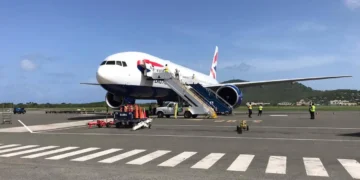




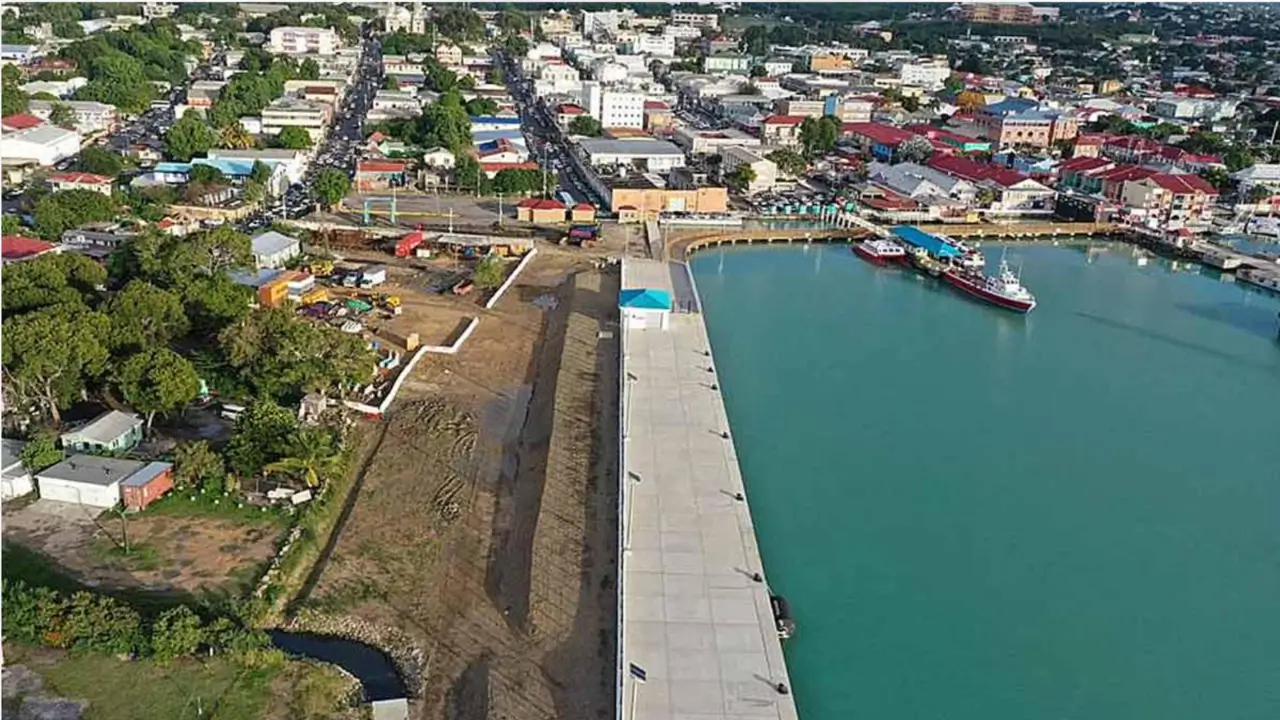
ST. JOHN’S, Antigua and Barbuda — An escalating Antigua US port dispute has exposed a new diplomatic complication between Washington and St. John’s after Prime Minister Gaston Browne disclosed that American funding to replace Chinese-installed technology at the country’s main seaport is awaiting completion of a separate agreement to receive third-country nationals removed from the United States.
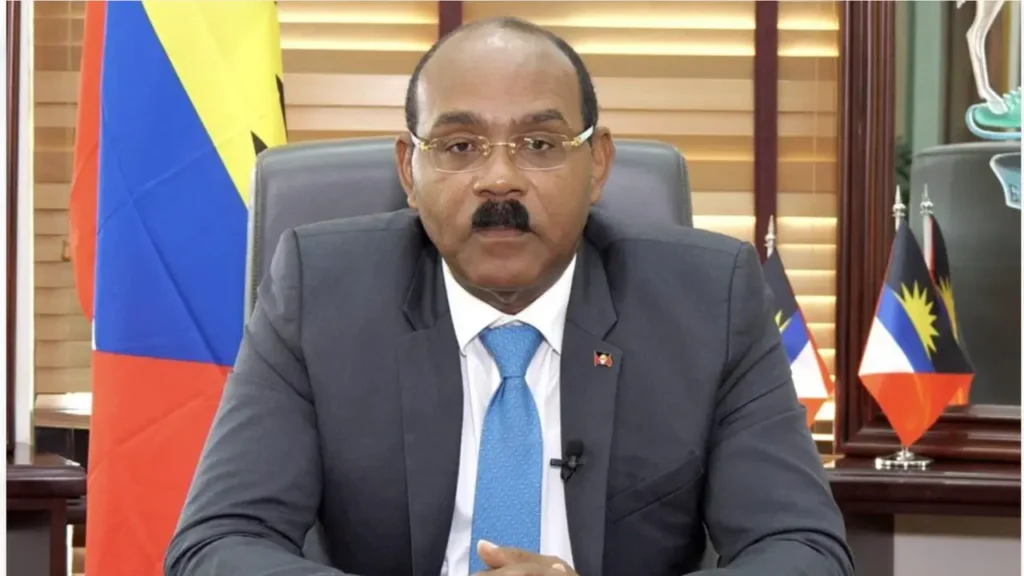
The disclosure has brought two sensitive issues into sharper focus: US concerns about potential Chinese surveillance capabilities at the strategically important St John’s Deep Water Harbour and Washington’s efforts to secure Caribbean cooperation with its immigration enforcement policies.
Browne said the United States had approved a grant to replace information technology installed during the Chinese-financed modernization of the port but had not released the funding pending completion of negotiations over the proposed transfer of third-country nationals.
The prime minister made the disclosure during his weekly Browne and Browne radio program in early October, according to local reporting. He said Washington had raised concerns that the Chinese-installed systems could potentially be used for surveillance, an allegation his administration firmly rejected.
The development raises questions about whether American financial assistance for critical infrastructure is becoming linked to broader diplomatic negotiations involving immigration, security and China’s expanding economic presence in the Caribbean.
No publicly disclosed technical assessment has established that Chinese spyware was installed at the port. The alleged connection between the grant and the immigration agreement is based on Browne’s account, and the specific conditions attached to the American funding have not been independently established.
US funding tied to third-country national negotiations
According to Browne, American officials expressed concerns about the information technology infrastructure installed as part of the Chinese-backed port redevelopment and indicated that they wanted the systems replaced.
The Antiguan government responded that it was prepared to cooperate, provided Washington financed the replacement.
Gaston Browne subsequently said Antigua and Barbuda Port Authority General Manager Darwin Telemaque had informed him that the United States had approved the necessary funding.
“They have approved a grant. They’re now waiting for us to complete the TCN agreement, and they’ll make that grant available,” Browne said.
TCN refers to third-country nationals, people who are neither citizens of the United States nor the country being asked to receive them.
The prime minister did not disclose the grant’s value, identify the American agency responsible for administering it or provide a timetable for replacing the port’s technology.
His account suggests that progress on one diplomatic issue could affect funding for another, although the precise nature of the relationship between the two negotiations remains unclear.
The United States has been pursuing agreements with several Caribbean governments to facilitate the transfer of foreign nationals who are subject to removal from American territory.
Antigua and Barbuda has maintained that any such arrangement must preserve its sovereign authority to determine who enters the country and must include adequate financial, legal and security safeguards.
The government has also rejected the suggestion that it should accept an unlimited number of individuals or assume responsibility for people without appropriate screening.
Chinese Surveillance Concerns Deepen Antigua US Port Dispute
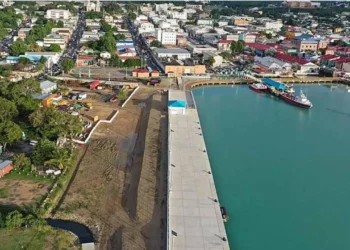
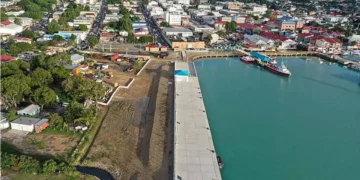
At the center of the controversy is the St John’s Deep Water Harbour, one of Antigua and Barbuda’s most important commercial infrastructure facilities.
In January 2018, Antigua and Barbuda entered into an agreement with the state-owned China Civil Engineering Construction Corporation to modernize the port.
The project, valued at approximately US$90 million, was financed through a concessional loan from the Export-Import Bank of China.
The redevelopment included improvements to cargo-handling infrastructure and port operations, supporting the government’s ambition to establish Antigua and Barbuda as a stronger maritime logistics and transshipment hub in the Eastern Caribbean.
The modernization project was completed in 2022, with Chinese authorities confirming that the renovated facility had received final acceptance from the Antigua and Barbuda Port Authority.
The port’s strategic importance extends beyond commercial shipping. Maritime facilities are essential to customs enforcement, cargo security, regional supply chains and the movement of goods throughout the Caribbean.
Information technology used to manage port operations can process commercially sensitive data, including cargo movements, vessel activity and logistical information.
Such capabilities explain why governments increasingly scrutinize the cybersecurity and ownership arrangements associated with critical transportation infrastructure.
However, the presence of Chinese-manufactured or Chinese-installed technology does not, by itself, establish that espionage is occurring.
Browne acknowledged that Washington had expressed concerns about the possibility of surveillance but said his government had no evidence that the port modernization project was designed to facilitate Chinese intelligence operations.
“There was no conspiracy to provide any opportunity for any spyware to be installed in our port,” he said.
The prime minister characterized the American concerns as speculation rather than evidence of an identified security breach.
He nevertheless indicated that his administration was willing to replace the systems to address Washington’s concerns.
That position reflects an effort to maintain cooperation with the United States without accepting allegations that Antigua and Barbuda’s economic relationship with China poses a threat to American security.
Antigua seeks strict limits on US deportee transfers
The port controversy comes amid prolonged negotiations over Washington’s proposal for Antigua and Barbuda to receive third-country nationals removed from the United States.
On September 28, the Antiguan government publicly released the American proposal and its own counter-proposal, emphasizing that no final operational agreement had been concluded.
The government’s counter-proposal established a maximum of seven individuals during any three-month period, equivalent to a potential ceiling of 28 annually.
That figure represents a maximum rather than an obligation to accept any particular number of people.
Under the proposed framework, each individual would require prior written approval from Antigua and Barbuda.
The government also outlined requirements covering criminal and security screening, health assessments, immigration history, travel documentation and the legal status of transferred individuals.
Additional provisions would require satisfactory financial arrangements to prevent the program from becoming a burden on Antiguan taxpayers.
The proposal would also preserve the government’s right to suspend transfers if concerns arose involving national security, public health, public order, capacity or other serious circumstances.
These conditions reflect the administration’s position that cooperation with Washington must remain consistent with the country’s domestic laws and national interests.
The government has repeatedly emphasized that it will not surrender control over immigration decisions or automatically accept individuals proposed for transfer.
The negotiations have also raised questions about the financial responsibilities associated with accommodating foreign nationals, including housing, health care, administrative services and eventual return or onward relocation.
The negotiations are part of a wider regional development. Neighboring St Kitts and Nevis has also reached an agreement with the United States concerning deportee transfers, highlighting how Caribbean governments are responding to Washington’s immigration enforcement initiatives.
In an October 12 update, Gaston Browne said discussions were nearing completion but that compensation and support arrangements would need to be addressed separately.
He indicated that Antigua and Barbuda wanted to avoid receiving individuals before securing the resources necessary to support them.
The administration has also explored arrangements involving an international organization that could assist with managing the transfers and facilitating lawful onward movement.
No initial transfer would occur until the required arrangements had been concluded and become operational, Browne said.
US visa restrictions add to diplomatic tensions
The dispute over Chinese technology and deportee transfers comes against a backdrop of additional immigration-related tensions between Antigua and Barbuda and the United States.
Antiguan and Barbudan nationals have been subject to American visa restrictions, while certain eligible applicants for new visitor visas are also covered by a visa bond requirement.
According to the US Department of State, Antigua and Barbuda was included in the visa bond program effective January 21, 2026.
Under the program, affected applicants who are otherwise eligible for B-1 or B-2 visitor visas may be required to post refundable bonds of US$10,000, US$15,000 or US$20,000.
The amount is determined by consular officials, and payment is required only when an applicant is directed to post a bond.
The bond does not guarantee admission to the United States, and refunds are governed by the program’s compliance requirements.
Washington has described the program as an immigration compliance measure intended to discourage visa overstays.
Antigua and Barbuda, however, has expressed concern about the impact of the restrictions on its citizens.
In August, Gaston Browne wrote to President Donald Trump requesting a review of the measures, while Antigua and Barbuda’s ambassador to Washington, Sir Ronald Sanders, pursued the matter through diplomatic channels with Secretary of State Marco Rubio.
The Antiguan government has argued that the restrictions impose difficulties on legitimate travelers and could adversely affect longstanding economic, family and commercial relationships.
Although the visa measures, port technology dispute and deportee negotiations are occurring simultaneously, no publicly established evidence demonstrates that all three are components of a coordinated American pressure campaign.
Nevertheless, their combined effect has created a more complicated diplomatic environment for a small Caribbean state seeking to maintain productive relations with Washington.
Chinese investment places Antigua between competing powers
The controversy also illustrates the challenges facing Caribbean governments as economic competition between the United States and China extends into infrastructure development, telecommunications and maritime security.
China has become a significant development partner for Antigua and Barbuda, supporting projects involving transportation, public infrastructure and other economic priorities.
The St John’s port redevelopment forms part of that broader relationship and was intended to improve commercial efficiency and strengthen the country’s position in regional trade.
For Antigua and Barbuda, access to development financing is particularly important because large infrastructure projects can place substantial demands on the resources of small island economies.
Chinese financing has provided opportunities to undertake projects that might otherwise be difficult to implement.
At the same time, Washington has increasingly emphasized the security implications of foreign technology operating within strategically important infrastructure.
The concerns extend to the possibility that technology suppliers could obtain access to sensitive operational information or create vulnerabilities in critical systems.
Those broader concerns, however, must be distinguished from any specific allegation of espionage at the Antiguan port.
Browne has maintained that his government’s relationship with Beijing is based on economic development rather than participation in geopolitical competition against the United States.
“Our relationship with China is not a threat to the United States,” he said.
He described the United States as Antigua and Barbuda’s “big brother” and China as its “big sister,” reflecting his argument that the country should be able to maintain constructive relationships with both powers.
The prime minister has also emphasized that the United States remains a major tourism source market, trading partner and longstanding security ally.
His administration’s willingness to replace the Chinese-installed technology suggests an effort to accommodate American security concerns while avoiding a diplomatic confrontation with Beijing.
However, the reported connection between the American grant and the deportee negotiations introduces an additional complication.
It leaves Antigua and Barbuda balancing the potential benefits of US-funded technology upgrades against its insistence that immigration arrangements must satisfy the country’s legal, financial and security requirements.
Port upgrade and immigration agreement remain unresolved
The immediate questions concern when Antigua and Barbuda will finalize its negotiations with Washington, whether the American grant will be released and what technical changes will ultimately be made at the port.
The government has not publicly disclosed the amount of the proposed grant or a detailed implementation schedule for replacing the Chinese-installed systems.
It also remains unclear whether Washington will require a complete replacement of the existing information technology infrastructure or whether specific components could be upgraded to address security concerns.
Any transition would need to account for the port’s continuing commercial operations and the protection of sensitive information during the replacement process.
Meanwhile, the proposed third-country national arrangement remains subject to the government’s stated requirements for individual screening, financial support and operational safeguards.
Browne’s October comments indicate that negotiations have advanced, but they do not establish that a final agreement has been implemented or that the port funding has been disbursed.
The next significant developments will be the formalization of any immigration agreement, confirmation of the American grant’s conditions and the announcement of a timetable for upgrading the port’s technology.