
















NEW YORK — The World Cup group stage came to a dramatic close on June 27 as Groups K and L completed the final slate of first-round matches, confirming the last teams to advance to the Round of 32. England and Colombia secured first place in their respective groups, Croatia and Portugal moved through as runners-up, and the Democratic Republic of Congo reached the knockout stage for the first time in its World Cup history.
The final day also delivered one of the tournament’s most dramatic finishes, as Austria and Algeria played to a 3-3 draw that sent both teams through while eliminating Iran despite its unbeaten group-stage campaign. England defeated Panama 2-0, Croatia edged Ghana 2-1, Colombia and Portugal drew 0-0, DR Congo rallied past Uzbekistan 3-1, and Austria and Algeria shared the points in a six-goal thriller.
England and Colombia claim first place
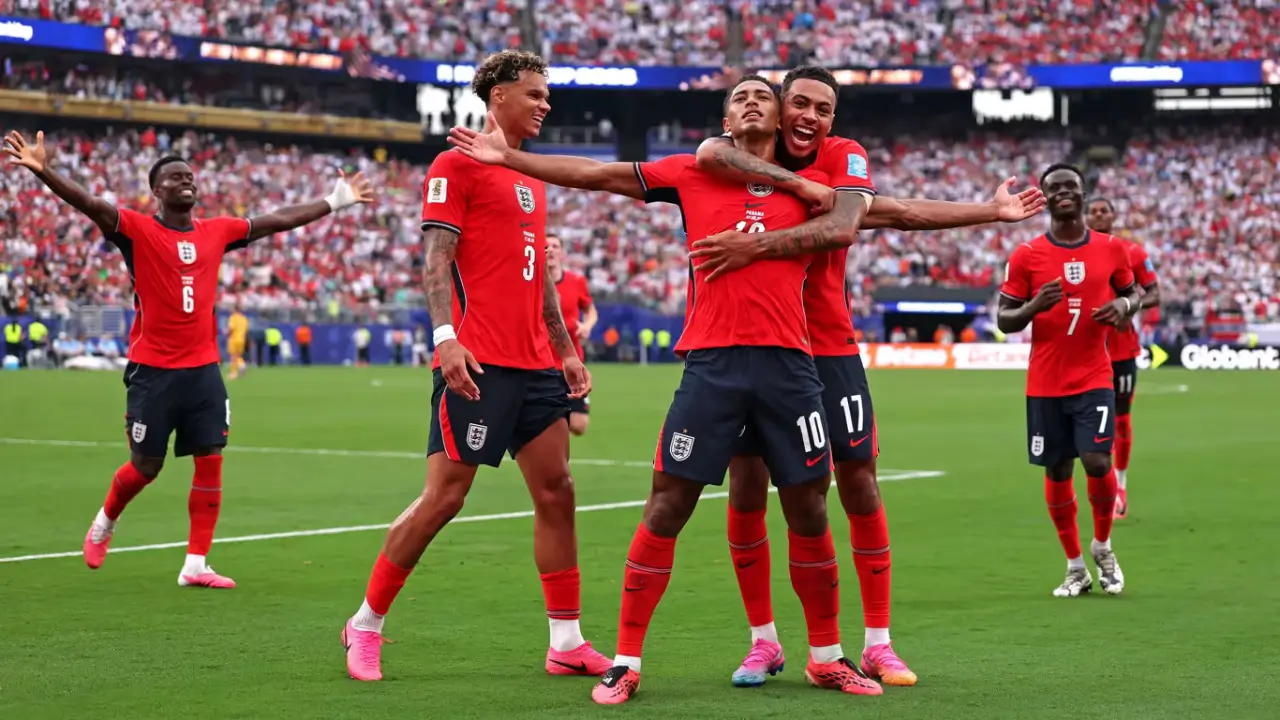
England entered its final Group L fixture knowing victory would secure first place, but Panama frustrated Thomas Tuchel’s side for more than an hour with disciplined defending and organized midfield play.
The breakthrough came in the 62nd minute when Jude Bellingham found space inside the penalty area and finished calmly to give England the lead. Five minutes later, Bellingham delivered a precise cross that Harry Kane headed home to seal a 2-0 victory.
Kane’s goal carried added significance, becoming his 11th career World Cup goal and moving him past Gary Lineker as England’s all-time leading men’s World Cup scorer. Bellingham was also central to England’s control of the match, finishing with a goal and an assist while helping dictate the tempo in midfield.
England completed the group stage unbeaten and advanced with momentum after improving across its three matches.
Croatia claimed the second automatic qualification spot from Group L after defeating Ghana 2-1.
Petar Sučić opened the scoring before Derrick Luckassen equalized for Ghana shortly after halftime. Croatia responded with the decisive goal to secure all 3 points and continue its World Cup campaign.
Although Ghana failed to advance, it remained competitive throughout the group stage and produced one of its strongest performances in a draw against England.
Colombia secured first place in Group K after a 0-0 draw with Portugal.
The result gave Colombia the point it needed to remain above Portugal in the standings and complete an unbeaten group-stage campaign. Colombia’s defensive organization and attacking balance helped it navigate one of the more competitive groups in the expanded tournament.
Portugal also advanced, finishing second in Group K after two draws and a dominant victory over Uzbekistan earlier in the group stage. Roberto Martínez’s side showed flashes of attacking quality but could not find the breakthrough against Colombia in the final match.
DR Congo reaches historic milestone
One of the day’s biggest stories belonged to DR Congo.
After conceding an early goal to Uzbekistan, the African nation mounted an impressive comeback to earn a 3-1 victory and qualify for the World Cup knockout stage for the first time in its history.
Yoane Wissa scored twice during an outstanding second-half performance as DR Congo overturned the deficit with energetic attacking football.
The victory secured one of the tournament’s coveted best third-placed qualification positions, highlighting the opportunity created by FIFA’s expanded 48-team format.
Uzbekistan’s first World Cup appearance ended in elimination, although the Central Asian nation remained competitive in stretches and showed encouraging signs for future international competitions.
DR Congo’s breakthrough carried wider significance for African football, giving the continent another representative in the knockout phase and rewarding a team that refused to protect a narrow path to qualification. Instead of settling after falling behind, DR Congo pushed forward and was rewarded with one of the defining results of the final group-stage day.
Late drama brings the World Cup group stage to a dramatic close
The final match of the group stage produced one of the tournament’s most dramatic finishes.
Austria and Algeria played to an extraordinary 3-3 draw that featured two stoppage-time goals and repeatedly changed the live qualification picture. Both teams fought for survival in a match where one goal could decide not only their fate, but also the future of other teams waiting on the third-place table.
During the closing minutes, Algeria appeared to have scored the goal that would eliminate Austria. Moments later, Austria responded with a dramatic equalizer that ultimately allowed both nations to advance.
The result ended Iran’s World Cup campaign in painful fashion.
Iran completed the group stage unbeaten with three draws and briefly appeared to have secured one of the final best third-placed qualification places. Austria’s late equalizer changed the standings and pushed Iran below the qualification line on tournament tiebreaking criteria.
The dramatic conclusion illustrated how narrow the margins became under the expanded format, where goal difference, goals scored and late goals across simultaneous matches determined the final knockout field.
Several tactical themes also emerged from the final day of group play.
England again benefited from midfield runners arriving late into the penalty area, with Bellingham’s movement proving decisive against Panama’s compact defensive structure. Colombia showed defensive discipline and game management in holding Portugal scoreless, while DR Congo demonstrated the value of remaining aggressive after falling behind.
Austria and Algeria, meanwhile, showed the importance of mental resilience in a match that swung repeatedly before both teams survived.
The final standings confirmed Colombia as Group K winner, followed by Portugal. DR Congo advanced as one of the best third-placed teams, while Uzbekistan was eliminated. England finished first in Group L ahead of Croatia, with Ghana and Panama exiting the tournament. The official final standings and knockout bracket were published by FIFA
England finished first in Group L ahead of Croatia. Ghana and Panama exited the tournament.
Austria and Algeria also secured progression through the third-place route, while Iran, South Korea, Scotland and Uruguay were among the notable teams to miss out on the remaining qualification places.
Several players defined the day. Bellingham scored once and assisted Kane while controlling England’s midfield. Kane set a new national World Cup scoring mark with his 11th tournament goal. Wissa’s two-goal performance sent DR Congo into the knockout rounds for the first time, while Austria and Algeria combined to produce one of the most memorable matches of the group stage.
Attention now turns to the Round of 32, where every remaining match becomes a win-or-go-home contest. Among the headline fixtures are Canada against South Africa, Brazil against Japan, the Netherlands against Morocco, France against Sweden, England against DR Congo, Argentina against Cabo Verde, Portugal against Croatia, and Colombia against Ghana.
The Round of 32 schedule provides a full look at the confirmed knockout fixtures following the conclusion of the group stage.
With the World Cup group stage complete and the knockout bracket finalized, the race for football’s biggest prize enters its decisive phase. Every remaining nation now stands one defeat from elimination and one victory closer to lifting the 2026 FIFA World Cup trophy.